 中文
 Email
 QCloud
 Log in


Quantum Interface Devices and Systems Group Achieves Customized Itinerant Frequency Combs Based on a Cascaded Nonlinear Architecture
2026/10/10
Recently, the Quantum Interface Devices and Systems Group at the Beijing Academy of Quantum Information Sciences (BAQIS), in collaboration with Tsinghua University, Hunan Normal University, and the University of Science and Technology of China, reported progress in Customized itinerant frequency combs enabled by a cascaded nonlinear system. The team constructed a cascaded third-order nonlinear system comprising a superconducting cavity electromechanical device and a high-electron-mobility transistor (HEMT), realizing an itinerant frequency comb with real-time tunability of its center frequency, comb spacing, and number of spectral lines, and demonstrated comb splicing and subdivision. The results were published on September 27, 2026, in Advanced Science under the title “Customized Itinerant Frequency Combs by Cascaded Nonlinear Effects.”
A frequency comb comprises a series of equally spaced frequency components and is widely used in atomic clocks, optical communications, molecular fingerprinting, optical metrology, and other fields. The center frequencies of conventional microcavity Kerr and optomechanical frequency combs are fixed near the cavity resonance, which hinders flexible tuning.
To overcome this limitation, the research team constructed a two-stage cascaded nonlinear system (Figure 1), in which a superconducting cavity electromechanical device serves as the first stage and a high-electron-mobility transistor (HEMT) as the second. The electromechanical device comprises a superconducting microwave circuit and an aluminum thin-film drumhead mechanical resonator. A coherent pump is first coupled into this device, where radiation-pressure interaction generates an optomechanical frequency comb centered at the pump frequency with a spacing equal to the mechanical frequency. This comb then serves as the seed for the HEMT, where cascaded third-order nonlinear mixing with a frequency-tunable weak probe generates a new itinerant frequency comb. The resulting comb preserves the seed spacing, while its center frequency is dictated entirely by the probe, thereby decoupling it from the cavity resonance. Consequently, the center frequency can be tuned arbitrarily across the 4–8 GHz microwave band, and the comb operates at single-photon-level probe power with a threshold of only 4.47 nW.
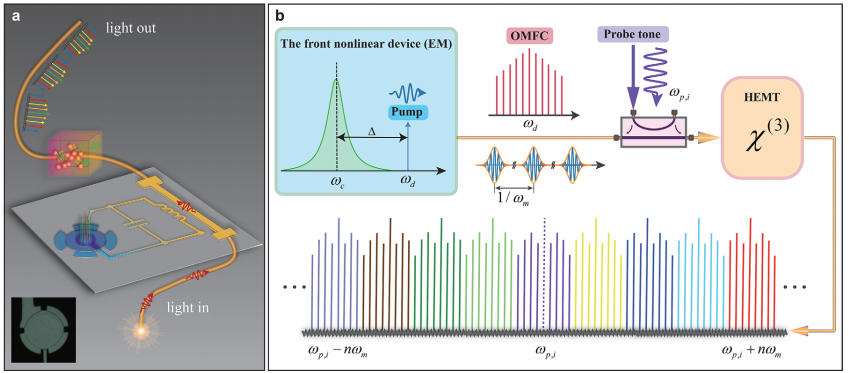
Figure 1 Cascaded nonlinear system and generation principle of itinerant frequency comb. (a) Cartoon of the physical realization of the cascaded nonlinear system. (b) Generation principle of the customized itinerant frequency combs.
The research team further demonstrated splicing and subdivision of the frequency comb. Using 15 independently tunable probe signals, each generating its own itinerant frequency comb, the 15 frequency combs were seamlessly spliced into an ultrawide frequency comb with a bandwidth of up to 2.6 GHz, and the number of spectral lines was increased to ten times that of the original frequency comb (Figure 2). By precisely setting the probe-signal frequency interval to one-fifteenth of the mechanical frequency, the team further achieved comb subdivision, thereby effectively improving the accuracy of the cascaded frequency comb.
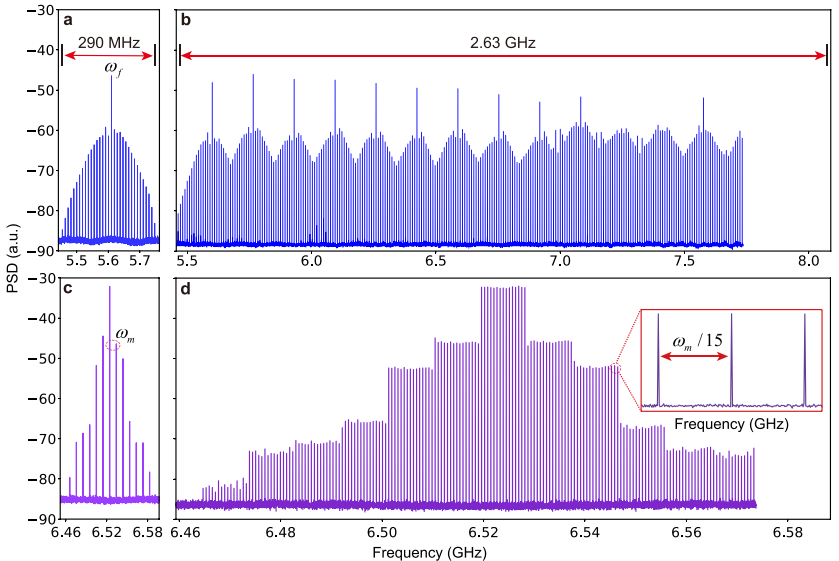
Figure 2 The splicing and subdivision of itinerant frequency combs.
This study provides a new type of frequency comb with a real-time tunable center frequency for microwave photonics. Through cascaded nonlinear effects, its center frequency is decoupled from the cavity resonance; the center frequency, comb spacing, and number of spectral lines can be customized in real time at single-photon-level probe power, and spectral resources can be flexibly expanded through splicing and subdivision. This provides a new method for precise control of key parameters of frequency combs and is expected to enhance the performance of existing applications such as optical communications, molecular fingerprinting, and optical metrology, while expanding new application scenarios.
The first authors of the paper are Yi Wang, a PhD student at Hunan Normal University (jointly supervised by Yulong Liu at BAQIS), and Zeji Li, a PhD student at Tsinghua University. The corresponding author is Associate Researcher Yulong Liu of BAQIS. Other collaborators include Wenyan Wang, Senior Engineer at BAQIS; Sihan Wang, PhD student at the University of Science and Technology of China; Dr. Cheng Wang of Aalto University (currently a postdoctoral researcher at the University of Waterloo); Professor Jingwei Zhou of the University of Science and Technology of China; Professor Jieqiao Liao of Hunan Normal University; and Professor Tiefu Li, jointly appointed at BAQIS/Tsinghua University. This work was supported by the National Natural Science Foundation of China, the National Key R&D Program of China, the Beijing Natural Science Foundation, and other funds.
Original link: https://doi.org/10.1002/advs.77903