 中文
 Email
 QCloud
 Log in


BAQIS Team Proposes and Demonstrates Transmitter-Device-Independent Quantum Key Distribution
2026/10/26
Recently, the quantum photonic communication and devices team of the Beijing Academy of Quantum Information Sciences (BAQIS) made an advance in quantum key distribution: for the first time, transmitter-device-independence was formalized within the one-sided device-independent trust model and experimentally validated, achieving an asymptotic secure key rate of about 410 bps over 27 km of fiber. This work eliminates the longstanding yet implicit transmitter-side device vulnerability in QKD systems and helps bridge the gap between security and practicality for real-world deployments. The results are reported in the paper “Transmitter-device-independent quantum key distribution”.
Quantum key distribution (QKD) derives its security from fundamental quantum principles, whereby any eavesdropping attempt necessarily introduces detectable disturbances. In practice, however, deviations of real devices from ideal designs can be exploited to compromise security. While the measurement-side trust problem has been largely addressed by measurement-device-independent (MDI) QKD and related schemes, the complementary transmitter-side device dependence has remained a longstanding yet implicit problem. Quantum steering, which intrinsically distinguishes the sender from the receiver, offers a natural route to lifting trust assumptions on the transmitter; but existing one-sided device-independent (1sDI) QKD protocols typically operate in a tripartite architecture, and adapting them to a transmitter–receiver architecture can introduce a signaling loophole.
To address this issue, the team formalized transmitter-device-independence on the basis of faithful quantum steering and proposed a practical TDI-QKD protocol within the 1sDI trust model (Figure 1). The scheme closes the signaling loophole by enforcing a causal isolation between the transmitter’s input information and the quantum states sent to the receiver, thereby eliminating transmitter-side device vulnerabilities. Unlike the strict relativistic causal arrangement used in quantum steering tests, the TDI protocol operates under a causal condition tailored to cryptographic settings, requiring only a storage delay on the scale of the receiver’s measurement interval. The paper also presents a concrete attack model exploiting this loophole.
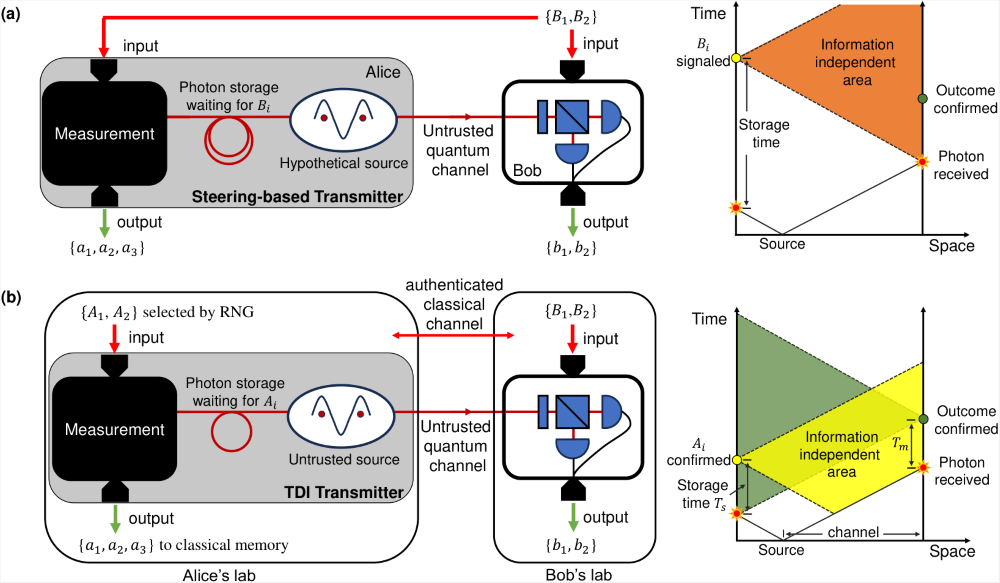
Figure 1. Schematic of the transmitter-device-independent QKD protocol.
In a proof-of-principle experiment, the team built a fully photonic, polarization-encoded platform (Figure 2). The transmitter comprises an entanglement source, a photon-storage module, and a measurement module, where a ~30 m fiber provides a 150 ns delay to enforce causal isolation (the receiver’s measurement interval is 50 ns). The channel loss to Bob was measured to be 7.5 dB (18% efficiency), and the entangled-state fidelity reached 98%. By accumulating 107 correlation rounds for each of the four input combinations and feeding the full probability distribution into a numerical security analysis, the team obtained an asymptotic key rate of 0.048 bits per round, corresponding to about 410 bps over 27 km of fiber (Figures 3 and 4). Theoretical simulations indicate that state-of-the-art single-photon detectors at the receiver could extend the distance to about 107 km.
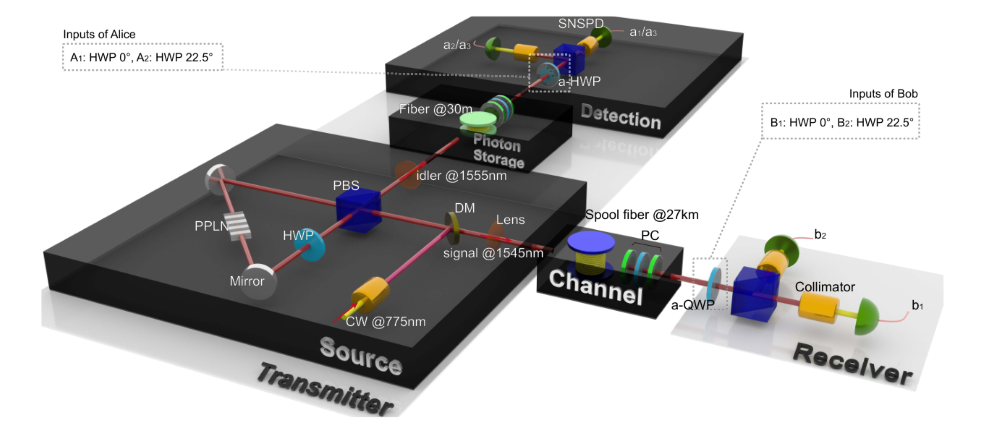
Figure 2. Experimental setup.
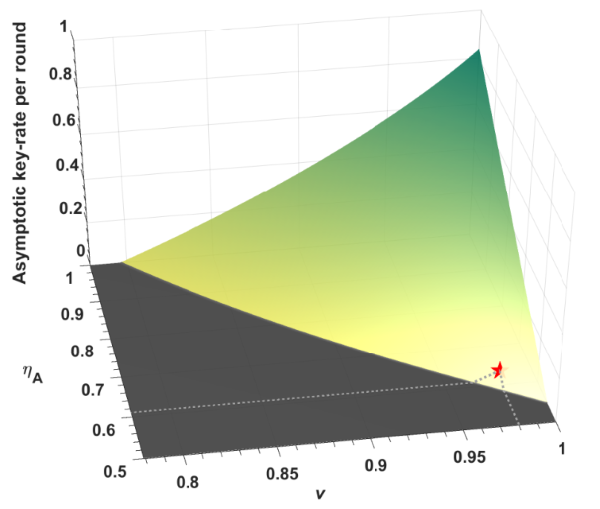
Figure 3. Key-rate bound determined by transmitter performance.
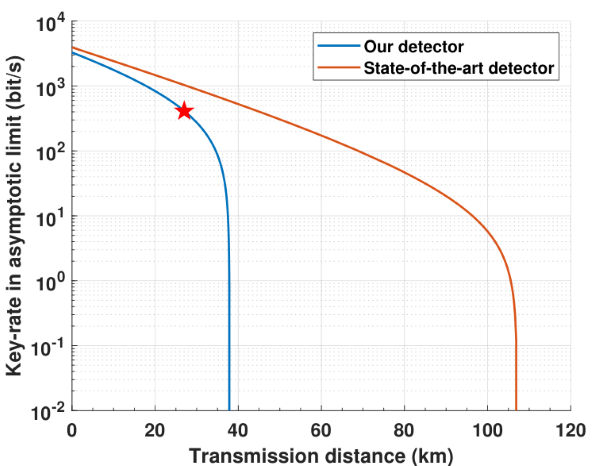
Figure 4. Asymptotically secure key-rate versus transmission distance.
This work removes transmitter-side trust requirements without sacrificing key-rate performance and is compatible with MDI and entanglement-swapping protocols, offering a route to longer transmission distances. The paper also systematically discusses practical issues such as fast basis switching, random number generation, finite-size effects, and the receiver-side fair-sampling assumption. By delivering transmitter-device-independent security while retaining strong loss tolerance, the approach helps bridge the gap between security and practicality for real-world QKD deployments.
The first and corresponding author of the paper is Zeng Qiang, associate researcher of BAQIS. The co-authors are Abhishek Mishra, PhD candidate of Université Libre de Bruxelles, Wang Haoyang, intern of BAQIS and PhD student of Beijing University of Posts and Telecommunications, and Yuan Zhiliang, chief scientist of BAQIS. This work was supported by the Innovation Program for Quantum Science and Technology, the BAQIS internal program, the Beijing Natural Science Foundation, the European Union’s Horizon Europe QSNP project, and Belgian funding agencies (F.R.S-FNRS and FWO).
Paper link: Transmitter-device-independent quantum key distribution
Team homepage: Quantum Photonics