 中文
 Email
 QCloud
 Log in


BAQIS Advances: Dissipative Acousto-Mechanical Parametric Interface between High-Overtone Acoustics and Flexural Phonons
2026/10/10
Recently, the research team of the Quantum Interface Devices and Systems at the Beijing Academy of Quantum Information Sciences (BAQIS), in collaboration with researchers from Tsinghua University and Aalto University, Finland, has developed a radiation-pressure-mediated dissipative acousto-mechanical coupling scheme. This approach enables coupling between gigahertz (GHz) high-overtone bulk acoustic resonators (HBARs) and sub-megahertz flexural modes of a silicon nitride (SiN) membrane. Operating in the resolved-sideband regime at room temperature, the system demonstrates a range of coherent acousto-mechanical phenomena, including acousto-mechanically induced transparency, amplification, and coherent acoustic frequency comb generation. The results, entitled “Dissipative Acousto-Mechanical Parametric Interface between High-Overtone Acoustics and Flexural Phonons”, was published in Physical Review Letters on October 7, 2026, and selected as an Editors’ Suggestion.
High-overtone bulk acoustic resonators (HBARs) in the gigahertz range offer exceptionally high frequency–quality-factor products (f ×Q) and can couple strongly to superconducting qubits at the single-phonon level. Suspended two-dimensional silicon nitride membranes have very low mechanical loss and operate at sub-megahertz frequencies, making them suitable for cavity optomechanics and sideband cooling to the ground state, with long coherence times. These two acoustic systems therefore offer complementary advantages for quantum technologies. However, efficiently coupling phonons across frequency bands separated by several orders of magnitude remains a longstanding challenge.
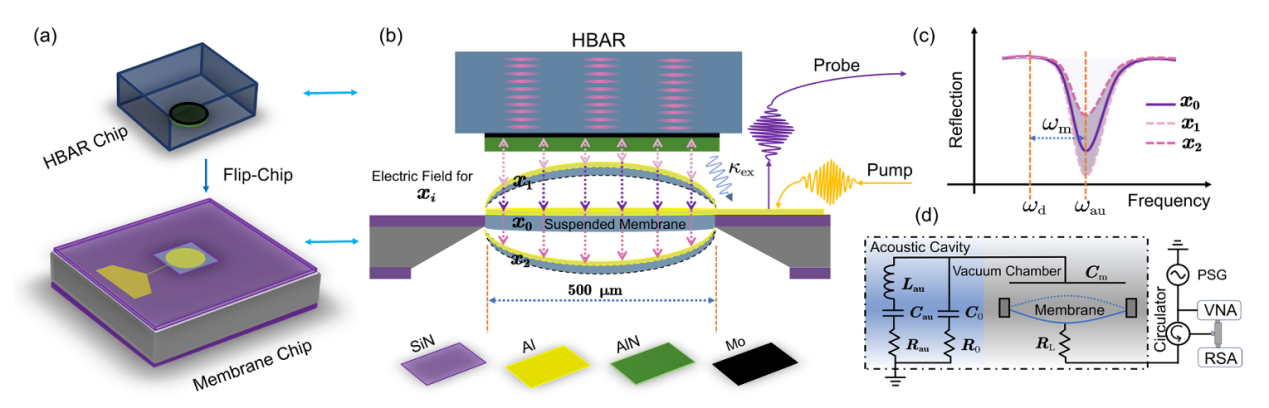
Figure 1. Device architecture and the dissipative acousto-mechanical coupling mechanism.
The device features a hybrid flip-chip architecture, illustrated in Fig. 1. The HBAR was fabricated on a 250-μm-thick sapphire substrate, while the mechanical resonator was a 50-nm-thick, low-loss SiN membrane. An aluminum coating on the membrane’s suspended window extends to the HBAR coupling port. Out-of-plane motion of the membrane therefore modulates the HBAR’s external dissipation rate, creating an optomechanics-like interaction in which displacement modulates dissipation. This architecture provides an effective route to realizing strong dissipative coupling in hybrid electromechanical systems.
Remarkably, the high quality factors of both modes allow the system to operate in the resolved-sideband regime without cryogenic cooling. Measurements showed a dense set of high-order longitudinal acoustic modes from 2.5 to 4 GHz, with a free spectral range of 21.37 MHz. The mode at 2.7454 GHz had a quality factor of approximately 1.89 × 10⁴. The fundamental flexural mode of the SiN membrane was at 571.5 kHz, with a relaxation time of 36.7 ms and an intrinsic damping rate of 8.68 Hz.
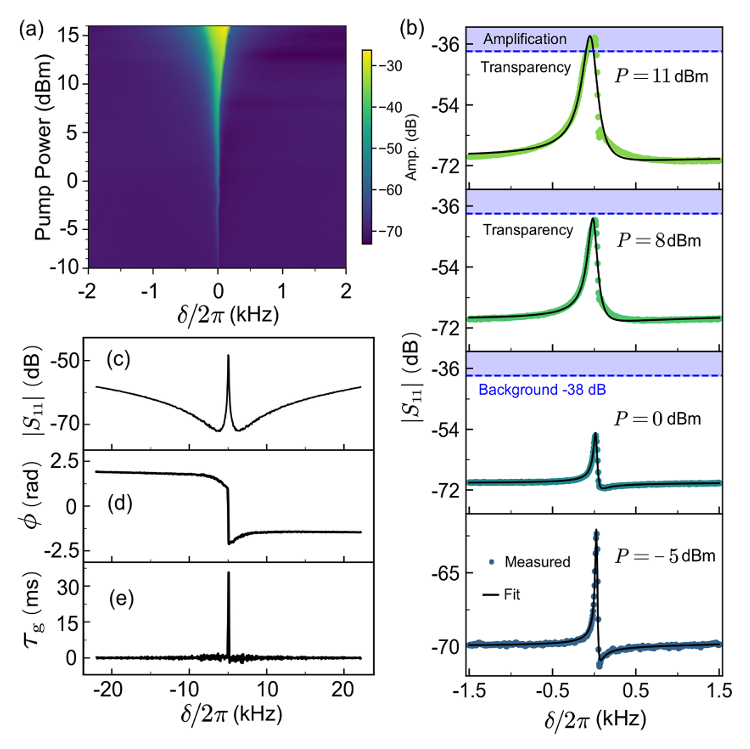
Figure 2. Evolution of the acousto-mechanically induced transparency window with pump power.
Acousto-mechanically induced transparency (AMIT) was observed under red-detuned pumping with a weak probe. As pump power increased, the transparency window broadened and showed features associated with dissipative coupling, including an asymmetric shape and a peak above the background. At a pump power of 11 dBm, fitting results revealed that the effective dissipative coupling strength was approximately 20 times greater than the dispersive coupling strength. Furthermore, under strong red-sideband driving, the reflection spectrum exhibited amplification, a distinctive feature that does not arise in purely dispersive coupling systems (Fig. 2).
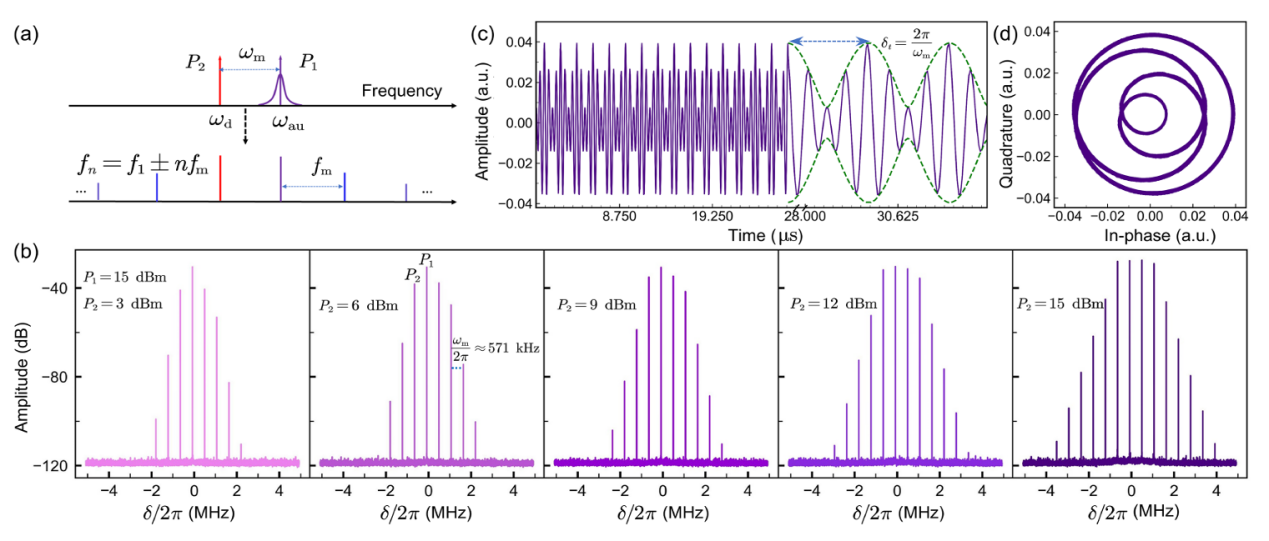
Figure 3. Two-tone driving scheme and coherent acoustic frequency comb.
Finally, leveraging the effective Kerr nonlinearity induced by strong driving, the team generated a coherent acoustic frequency comb using a two-tone driving scheme combining a resonant drive with a red-sideband pump. At a pump power of 15 dBm, the resulting comb exhibited a tooth spacing equal to the mechanical resonance frequency. The 1.75-μs periodicity observed in the time-domain signal, together with stable Lissajous orbits, confirmed long-range phase coherence among the comb teeth (Fig. 3).
Looking ahead, this platform offers a promising alternative to cryogenic superconducting electromechanical systems for precision measurement and sensing, owing to its room-temperature operation. Moreover, its compatibility with cryogenic environments opens up opportunities for quantum-regime applications, including the preparation of macroscopic quantum states of mechanical resonators, long-lived quantum state storage, and coherent state transfer between phonon modes. These capabilities could pave the way for scalable, on-chip multimode phononic information processing.
The co-first authors of paper are Xun Ji, a Ph.D. student at BAQIS, and Huanying Sun, an associate researcher at BAQIS. Yulong Liu, an associate researcher at BAQIS, and Tiefu Li, an adjunct researcher at BAQIS and an associate professor at Tsinghua University, serve as the corresponding authors. The other co-authors are Qichun Liu, a senior engineer at BAQIS; Longhao Wu, a postdoctoral researcher at Aalto University; and Mika A. Sillanpaa, a professor at Aalto University. This work was supported by the National Natural Science Foundation of China, the Beijing Natural Science Foundation, the National Key Research and Development Program of China, the European Research Council, the Research Council of Finland, and other funding sources.
Article: https://doi.org/10.1103/c2yn-qqv9