 中文
 Email
 QCloud
 Log in


Machine Learning Enhances the Readout of Weak Transient Responses in Rydberg-Atom Sensors
2026/09/04
Researchers from the Atomic Ensemble Precision Measurement Group at the Beijing Academy of Quantum Information Sciences (BAQIS) have reported new progress in reading out weak transient electric-field responses using Rydberg atoms. The team developed a machine-learning-assisted readout method that combines waveform-morphology discrimination with cross-cycle temporal-consistency refinement. By improving the reliable localization of weak Rydberg electromagnetically induced transparency (EIT) transients without altering the sensor’s underlying physical response, the approach addresses a key challenge in weak-signal measurement. The findings were published in Optics Express on September 3, 2026, in a paper entitled “Machine-learning-enhanced Rydberg transient readout of weak electric pulses.”
Rydberg atoms possess large electric dipole moments, making them highly sensitive to external electric fields. Through electromagnetically induced transparency, electric-field-induced changes in Rydberg energy levels can be converted into variations in probe-light transmission, enabling optical readout of radio-frequency and microwave electric fields. For continuous-wave or relatively strong signals, atomic responses can often be characterized directly through spectral shifts, Autler–Townes splitting, or clearly resolved time-domain waveforms. Weak, rapidly varying, broadband transients near the noise floor, however, present a more demanding problem. Their measured signatures are jointly shaped by the RF coupling path, atomic dynamics, and optical detection, and can be difficult to distinguish from background fluctuations and unrelated transient features. The central challenge therefore shifts from simply detecting a peak to identifying, among multiple similar candidates, the atomic response genuinely associated with the external excitation.
To investigate this problem, the researchers built an EIT-based weak-transient measurement system using the Cs 73D5/2 Rydberg state. An 852 nm probe laser and a 509 nm coupling laser established the optical readout channel, while an ultrahigh-frequency (UHF) coupling structure delivered controlled, fast, partial-discharge-like pulses to the region of the atomic vapor cell. In the signal-processing pipeline, matched filtering (MF) and normalized cross-correlation (NCC) were first used to identify candidate transient locations. Principal component analysis (PCA) and logistic regression were then applied to discriminate the local waveform shapes around those candidates. This strategy retains the value of template matching for candidate detection while incorporating information about signal polarity, pulse width, recovery behavior, and template similarity, rather than selecting an event solely on the basis of the largest correlation peak.
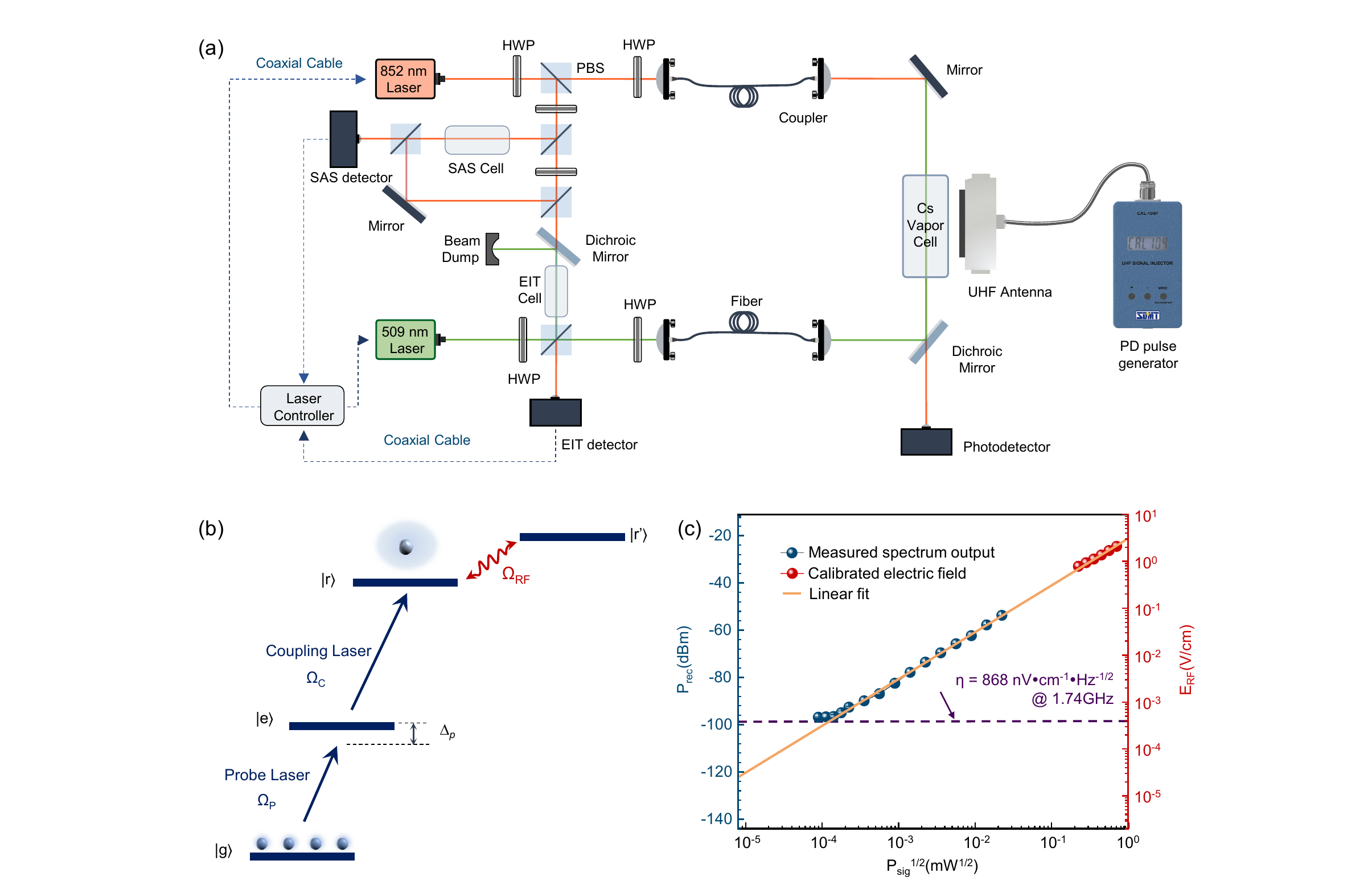
Figure 1. Rydberg-EIT weak-transient measurement system, energy-level configuration, and characterization of the narrowband electric-field response.
Experiments showed that, under relatively strong-response conditions, event-associated Rydberg-EIT transients could be identified directly in individual acquisition cycles. As the response approached the background noise level, however, the target transient lost its clear amplitude advantage, and other transient features could produce similarly strong template-correlation peaks. Nevertheless, after post hoc alignment using an independent timing reference from the pulse source, a reproducible local negative-going transient remained visible in the low-signal-to-noise-ratio (SNR) data. This finding indicates that low SNR does not necessarily mean that the waveform information has disappeared: even when a target response is no longer visually prominent in a single acquisition, its local morphology may still contain discriminative information that an algorithm can recover.
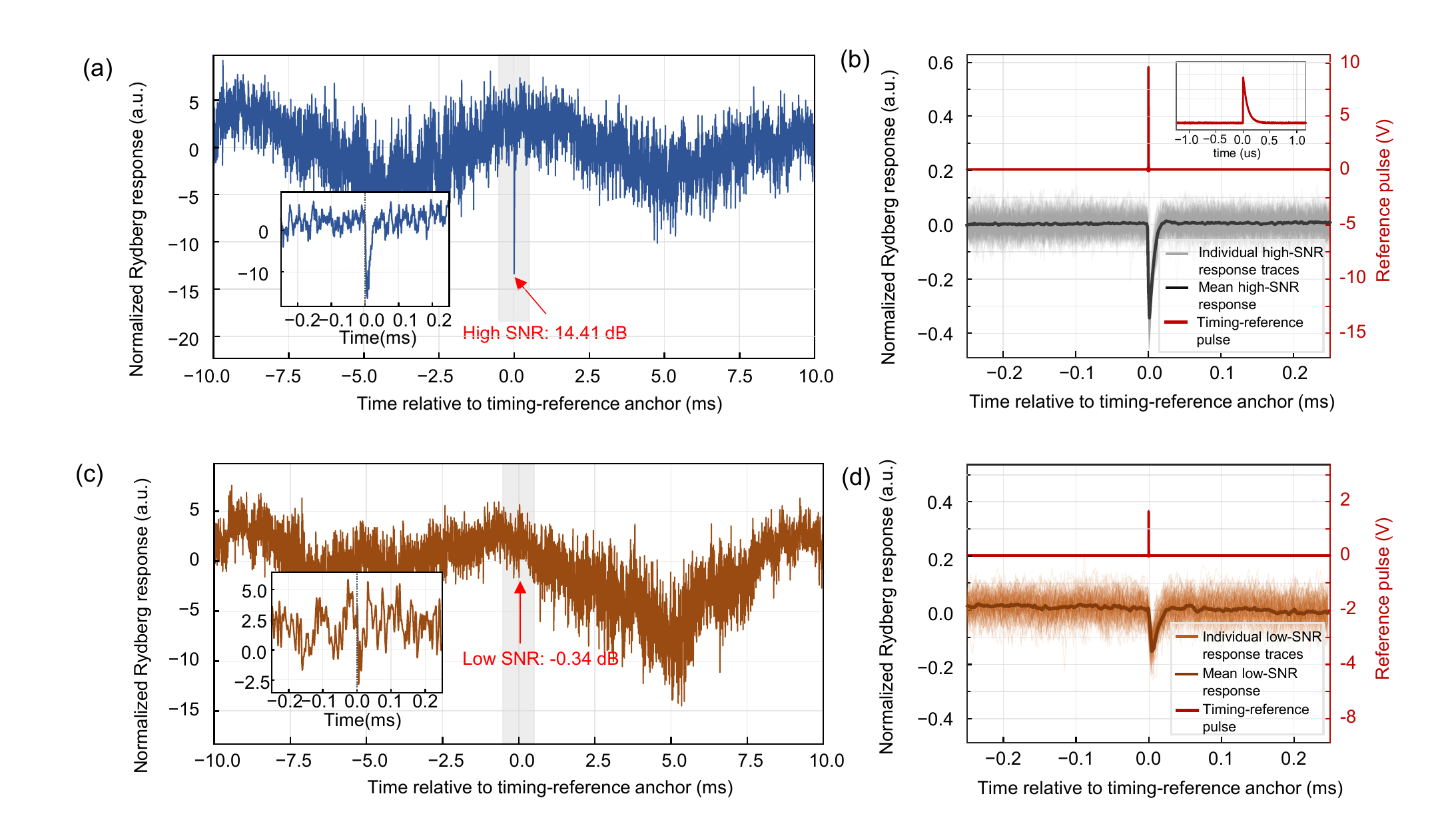
Figure 2. Rydberg-EIT transient responses at different signal-to-noise ratios and the corresponding post hoc alignment results.
The team subsequently evaluated the readout methods on 117 low-SNR acquisition cycles recorded directly in the experiment. Under the strict event-localization criterion, the conventional MF method based on the maximum correlation peak achieved an accuracy of 0.00%. Yet 115 of the 117 candidate pools contained at least one candidate satisfying that same localization criterion. The contrast shows that candidate generation was not the principal bottleneck; the more difficult task was ranking the correct candidate ahead of competing waveform features under low-SNR conditions. Incorporating PCA and logistic-regression-based waveform-morphology discrimination increased strict localization accuracy to 63.25% (74/117). Further refinement based on temporal consistency across cycles of controlled repeated excitation raised the accuracy to 86.32% (101/117). These results demonstrate that machine learning primarily improves candidate ranking, while cross-cycle temporal consistency provides an additional basis for resolving candidates with similar waveforms.
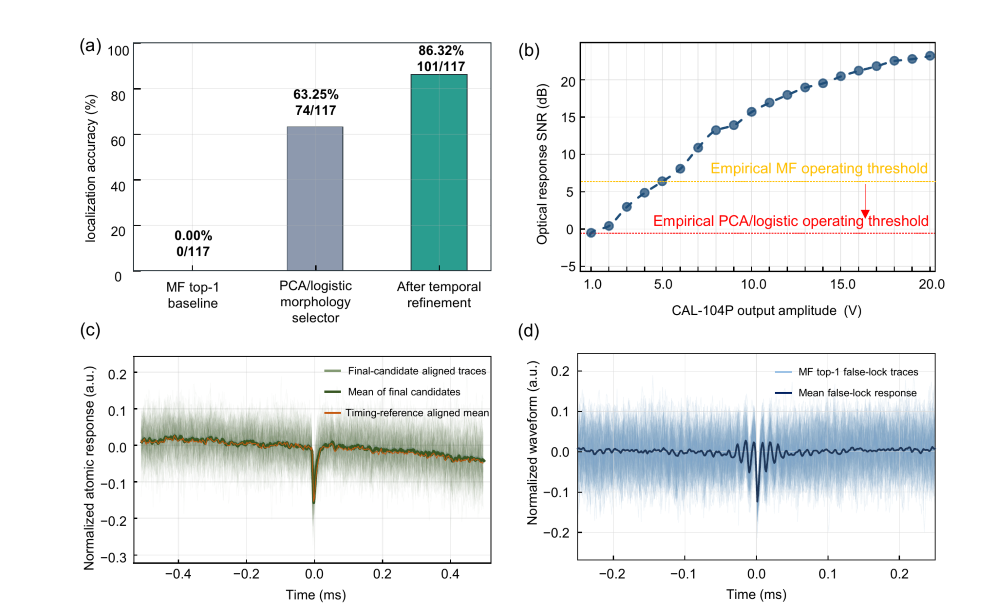
Figure 3. Performance of machine-learning-enhanced readout of low-SNR transient responses.
This work advances weak-transient Rydberg-atom measurement from producing a detectable response toward reliably extracting that response from complex backgrounds. More broadly, it highlights that the practical performance of quantum sensing depends not only on the intrinsic sensitivity of the sensing medium but also on how effectively weak physical information can be acquired and interpreted. In realistic electromagnetic environments, improving sensor sensitivity alone cannot resolve every difficulty associated with weak transient signals. The ability to distinguish meaningful physical responses from noise and interference is equally important for translating quantum sensing into practical use. By combining Rydberg-atom sensing with machine-learning-assisted readout, the team has extended measurement capabilities under weak-signal conditions and offered a route from highly sensitive laboratory detection toward more reliable sensing in complex, dynamic environments. With further validation of broadband measurement pathways, real discharge scenarios, and conditions involving multiple events, the approach could open up opportunities in power-equipment condition monitoring, the identification of complex electromagnetic events, and broader transient electric-field measurements.
The paper’s first author is Chunyang Jia, a doctoral student at BAQIS at the time of the study. The corresponding authors are Renfu Yang, a researcher at BAQIS, and Nan Cong, an associate researcher at BAQIS. Other co-authors include Yue Chang, an associate researcher; Wenhao Luo, an assistant researcher; and doctoral students Jiaao Li and Xuehua Chen, all from BAQIS, as well as engineers Xiaobo Song and Hongjia Wang from Beijing QuantaWell Technology Co., Ltd. The research was supported by projects of the State Grid Corporation of China and the National Natural Science Foundation of China, among others.
Original article: https://doi.org/10.1364/OE.607219