 中文
 Email
 QCloud
 Log in


BAQIS Makes New Progress in Research on Coherent Dynamics of Biexcitons in Monolayer WSe2
2026/09/03
Recently, the Ultrafast Spectroscopy team at Beijing Academy of Quantum Information Sciences (BAQIS) has made new progress in the study of exciton many-body physics in monolayer transition metal dichalcogenides (TMDs). Using helicity-resolved transient absorption spectroscopy, the team achieved the coherent generation and detection of intervalley neutral and charged biexcitons in monolayer tungsten diselenide (WSe2), and systematically revealed their coherent dynamics and the temperature-dependent evolution of binding energies. On Sep3rd, 2026, the related results were published online in Nano Letters 26 (37): 12290-12298 (2026) under the title “Coherent dynamics of neutral and charged biexcitons in monolayer WSe2.”
Monolayer TMD materials, owing to their strong Coulomb interaction and unique valley-dependent optical selection rules, are ideal platforms for studying many-body excitonic complexes. As higher-order excitonic complexes, biexcitons are of great value in quantum optoelectronic applications such as laser gain media and entangled photon sources. However, due to inhomogeneous broadening, defect perturbations, and impurities, the unambiguous identification and manipulation of biexcitons have long faced major challenges.
The research team used helicity-resolved transient absorption spectroscopy (helicity-resolved TAS) (Fig. 1a). Under an opposite-circular polarization (OCP) configuration (pump σ-, probe σ+), they used a narrowband pump to resonantly excite neutral excitons and a white-light supercontinuum as the probe, achieving highly sensitive coherent detection of intervalley biexcitons in photo-induced absorption (PIA) of monolayer WSe2 (Fig. 1b–d). This method effectively avoids interference from incoherent background and can simultaneously capture coherent signals from neutral and charged biexcitons. Through systematic pump-fluence-dependent experiments, the team found that the biexciton signal intensity depends linearly on pump fluence, a typical signature of an intrinsic coherent process, in sharp contrast to the superliner power dependence observed in photoluminescence (PL) measurements.
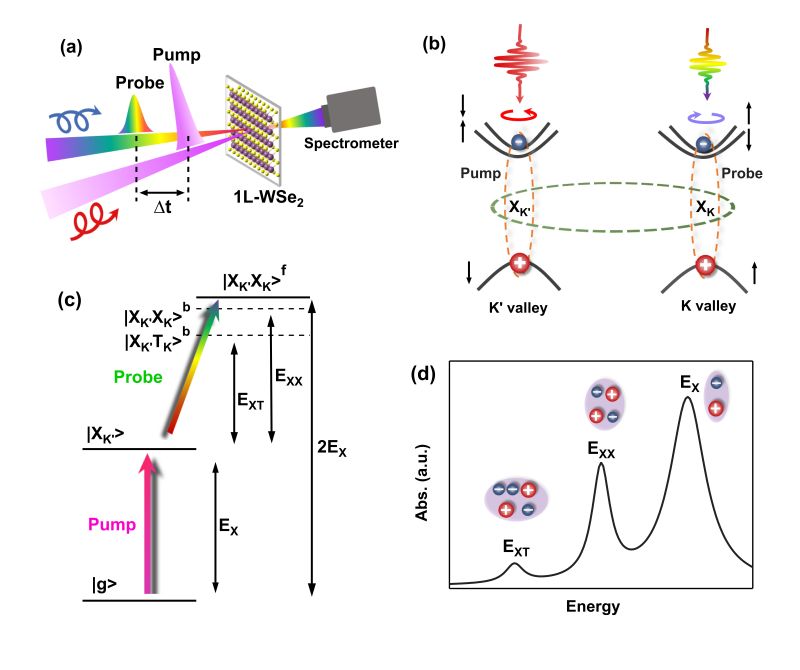
Figure1. Coherent generation and detection of intervalley biexcitons. (a) Illustration of helicity-resolved TAS. Pump and probe beams are set with OCP (σ-σ+). A narrow-band pump and a white-light continuum probe were employed in a pump-probe configuration, enabling the monitoring of exciton and biexciton dynamics. (b) Mechanism of coherent biexcitons generation. The left-circular polarization (σ-) pump creates A-exciton in the K′ valley, and the probe (right-circular polarization, σ+) monitors the unpumped K valley, allowing coherent generation and detection of biexciton dynamics. (c) Schematic of neutral (EXX) and charged (EXT) biexcitons coherently detected by TAS in an OCP configuration. The probe reads the PIA of neutral and charged biexcitons (|XK′XK〉b and |XK′TK〉b) following A-exciton formation by pump excitation. (d) Idealized transient absorbance spectrum showing the contribution from A-exciton (EX), neutral biexciton (EXX), and charged biexciton (EXT).
Their findings further revealed the temperature dependence of biexciton peak energies and binding energies (Fig. 2). The experimental data showed that the binding energies of neutral and charged biexcitons increase significantly with increasing temperature (Fig. 2b). By fitting the temperature dependence of exciton resonance energies using the Varshni equation and the O’Donell-Chen equation, the team found that the effective Debye temperature (~70 K) and average phonon energy (~8 meV) of biexcitons are significantly lower than those of neutral excitons (~170 K and ~15 meV). This phenomenon originates from the more extended wavefunctions and larger effective masses of biexcitons, making them more sensitive to thermal lattice vibrations and low-energy phonon scattering. These findings provide a new perspective for understanding the interactions among excitons, biexcitons, and other excited states in 2D materials.
In conclusion, the study shows that manipulating excitonic complex states through coherent spectroscopic methods is a key step toward quantum optoelectronic applications. This work not only deepens the understanding of biexciton coherent dynamics and demonstrates the powerful capability of transient absorption spectroscopy in studying exciton many-body physics, but also provides an important physical foundation for the future design of quantum optoelectronic devices based on 2D semiconductor materials.
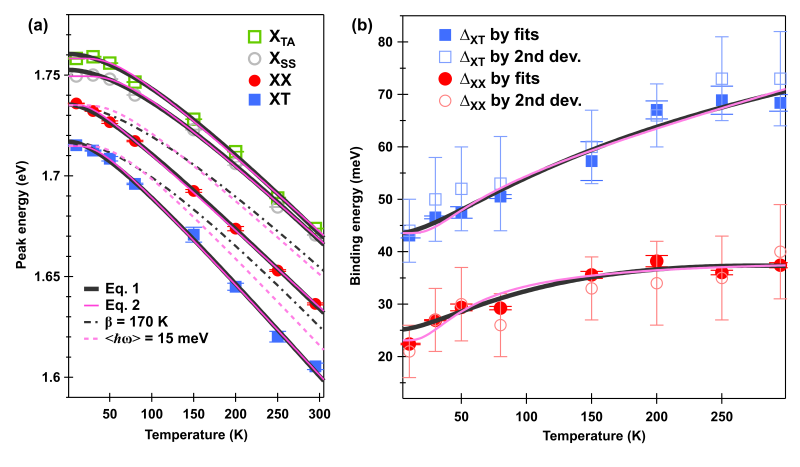
Figure 2. Temperature-dependent binding energies of biexcitons, measured by helicity-resolved TAS in an OCP configuration (a) Temperature-dependent peak energies of neutral (XX) and charged (XT) biexcitons, as well as that of A-exciton obtained from steady-state (XSS) and TAS (XTA) measurements. (b) Temperature-dependent binding energies of biexcitons. The filled blue squares and red dots correspond to ΔXT and ΔXX obtained from part (a). The black and pink curves are the energy differences between biexcitons and A-exciton, respectively.
The first author of the paper is Xiu Zhang, a PhD student at BAQIS (graduated). The corresponding authors are Haiyun Liu, associated professor at BAQIS, and Qihua Xiong, adjunct researcher at BAQIS and professor at Tsinghua University. Co-authors also include Tingxiao Qin, assistant researcher at BAQIS; Mengdi Zhang, senior engineer; Junzhi Zhu, PhD student; and Haiyun Huang (graduated). This work was supported by the National Key R&D Program of China, the National Natural Science Foundation of China, and the New Cornerstone Investigator Program.
Original link: https://doi.org/10.1021/acs.nanolett.6c02450