 中文
中文 Email
Email QCloud
 Log in

BAQIS Makes New Progress in Research on the Many-Body Thermalization Mechanism of Energy Relaxation in Superconducting Qubits
2026/08/27
Researchers at the Beijing Academy of Quantum Information Sciences (BAQIS) have made new progress in understanding the microscopic mechanisms behind energy relaxation in superconducting qubits.The research, conducted by the Intelligent Quantum Computing and Simulation team, provides a microscopic explanation for how apparently irreversible energy relaxation can emerge from the intrinsic dynamics of a finite many-body quantum system—without the need to assume an external heat bath or phenomenological dissipation.The findings build on the team’s earlier work on the microscopic dynamical origins of the second law of thermodynamics, which suggests that thermalization and the growth of thermodynamic entropy can arise from information erasure. From this perspective, energy relaxation in an open quantum system can be understood as a thermalization process involving the system and its environment as a whole.The new study develops a microscopic model in which a superconducting qubit is coupled to a finite, interacting many-body system of two-level systems (TLSs). The researchers show that intrinsic many-body dynamics can give rise to effective irreversible, exponential energy relaxation.The paper, titled “Energy Relaxation via Quantum Thermalization: A Superconducting Qubit Coupled to an Interacting Many-Body Two-Level System,” was published in APS Open Science on Aug. 19, 2026.
The coherence time of superconducting qubits has long been limited by defects in their material environment. TLSs—widely distributed in surface oxides, material interfaces and fabrication residues—can exchange energy with qubits through electric-dipole interactions.Interactions among TLSs can also cause frequency fluctuations and spectral diffusion, contributing to the fluctuations in relaxation times frequently observed in experiments.Conventional theoretical approaches often treat individual TLSs as independent environmental degrees of freedom that rapidly dissipate energy through phonons. Exponential decay is then described using tools such as Fermi’s golden rule or the Lindblad master equation.But a fundamental question remains: when phonon-mediated dissipation is strongly suppressed, how can a finite and interacting TLS environment generate irreversible relaxation purely from coherent microscopic dynamics.
This study addresses this question using an “information-erasure” framework for thermalization developed by the research team.The researchers divide the TLSs into two groups with different characteristic frequencies, denoted as τ-type and υ-type TLSs, and construct a finite many-body environment in the form of a seven-site one-dimensional chain. TLSs with similar frequencies are coupled through resonant transitions, while TLSs with different frequencies interact through effective ZZ couplings. The qubit is weakly coupled to a τ-type TLS at one end of the chain.The model also incorporates random fluctuations in TLS frequencies. By alternating between the system Hamiltonian and randomly perturbed Hamiltonians, the researchers construct a sequence known as full forward-time information erasure (FFTIE).The sequence represents frequency shifts and adiabatic phase perturbations generated by the device environment. These effects drive thermalization within the TLS network and progressively suppress the coherent return of energy to the qubit.
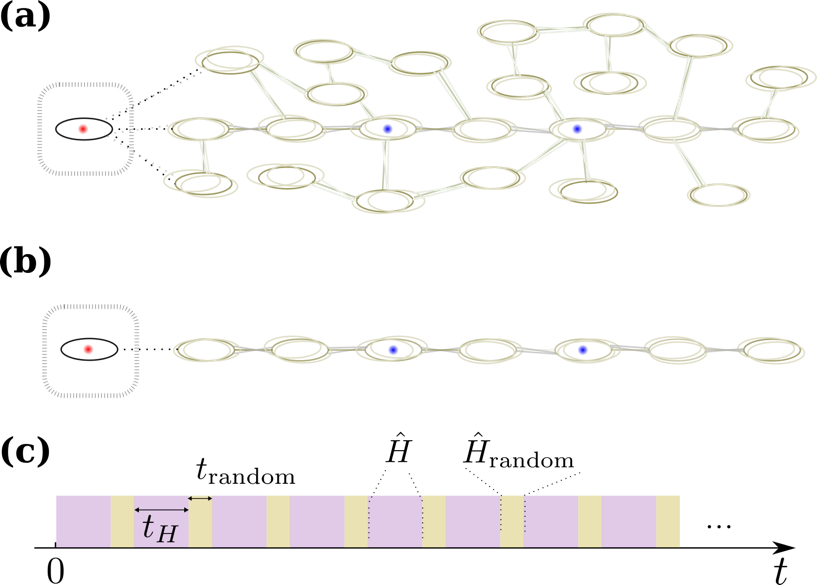
Figure 1. Superconducting Qubit–Many-Body TLS Model and FFTIE Sequence
Numerical simulations show that, under the FFTIE sequence, the initially reversible exchange of energy between the qubit and the TLS environment evolves into smooth exponential relaxation.Individual random trajectories exhibit irreversible decay, while the average occupation approaches the microcanonical equilibrium value of 1/8. The qubit’s coherence also decays exponentially.The researchers further found that the relaxation and decoherence times follow nearly inverse-square scaling with the qubit–TLS coupling strength. Specifically, the fitted scaling exponents for T1 and T2 were approximately -1.9969 and -1.9676, respectively. The simulations also yielded a ratio of T2/T1 of about 2.14.The near-inverse-square scaling is consistent with the behavior predicted by Fermi’s golden rule and Lindblad-based descriptions. However, in the new study, this behavior emerges microscopically from unitary many-body dynamics in a finite quantum system, rather than being imposed through an external dissipative model.
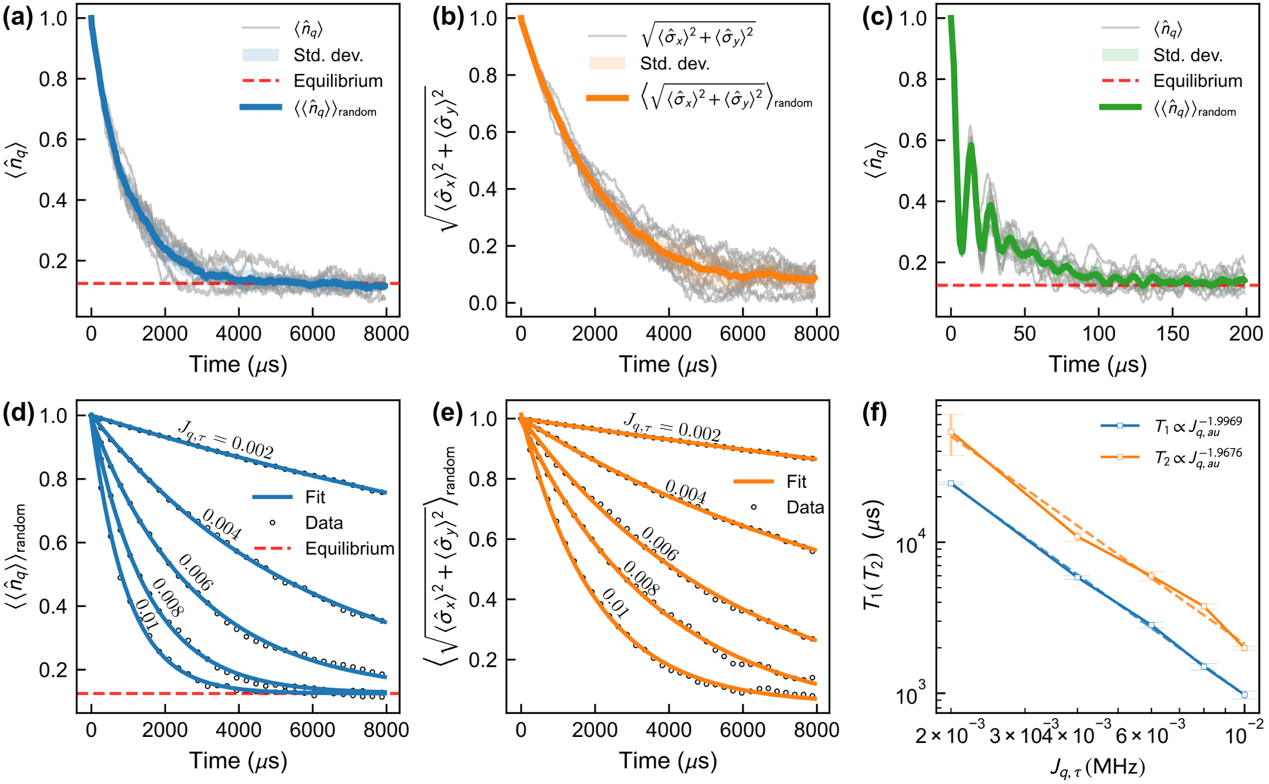
Figure 2. Many-Body Thermalization-Induced Exponential Qubit Relaxation, Decoherence, and T1/T2 Scaling
The study also reveals how microscopic properties of the TLS environment can influence qubit relaxation.As the interactions among TLSs become stronger, the many-body energy spectrum broadens and the number of effective channels near resonance with the qubit decreases. As a result, T1 gradually increases, eventually approaching saturation when the internal TLS coupling exceeds approximately 3 MHz.Increasing the frequency of the FFTIE perturbations can suppress coherent oscillations at an earlier stage of the evolution, allowing the system to enter a stable exponential-relaxation regime more quickly.
The researchers also examined the effect of the initial number of excitations in the TLS environment. Although changing the excitation number does not alter the near-inverse-square dependence of T1 on the qubit–TLS coupling strength, it can substantially change the absolute relaxation time.Within the parameter range studied in the paper, removing one excitation from a υ-type TLS nearly halves T1. This suggests that, in certain many-body parameter regimes, a lower effective temperature could paradoxically be associated with a shorter qubit lifetime.
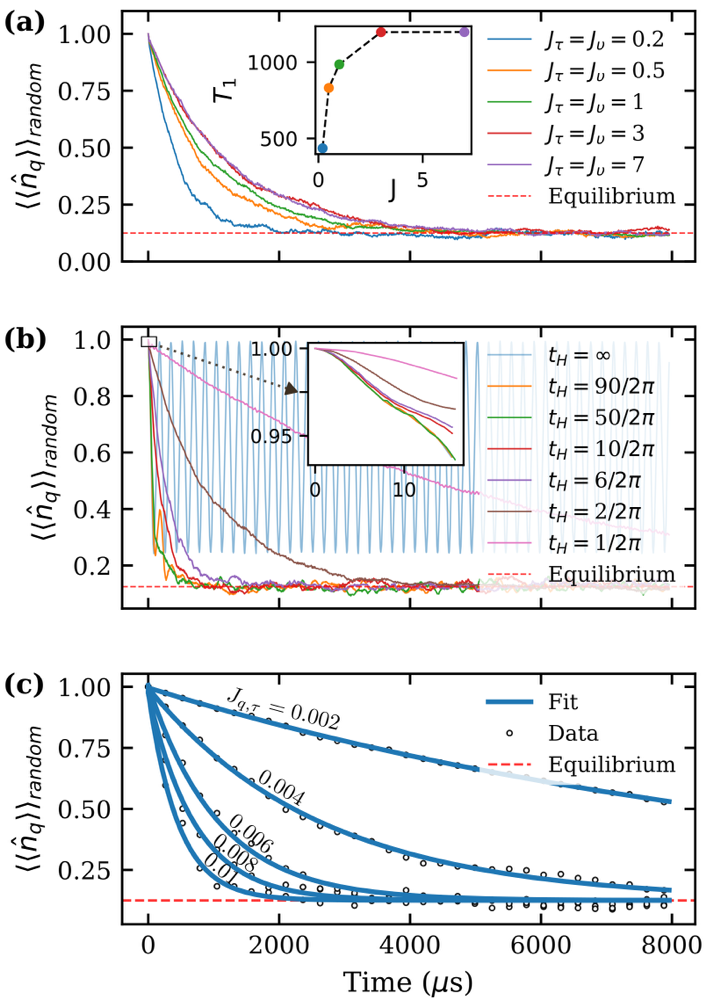
Figure 3. Effects of Many-Body TLS Environment Parameters on Qubit Relaxation
The study establishes a quantitative microscopic connection between information erasure, many-body thermalization and irreversible relaxation in superconducting qubits.According to the researchers, the results provide a finite-many-body dynamical foundation for the exponential decay and golden-rule scaling traditionally used in open quantum-system theory. They may also offer a new perspective on the long-standing experimental problem of fluctuations in qubit T1 times and their potential implications for quantum error correction.Looking ahead, the researchers suggest that emerging techniques for controlling TLSs and engineering phonon environments could be used to tune TLS excitation numbers, internal coupling strengths and the rate of frequency fluctuations.Such experiments could directly test the predicted crossover from coherent oscillations to exponential relaxation and help determine whether the theoretical framework remains valid in larger and more realistic TLS networks.
The work could ultimately contribute to a deeper understanding of microscopic noise mechanisms in superconducting quantum processors and provide new ways to control decoherence and improve qubit performance.
The paper’s sole author is Xue-Yi Guo, an assistant researcher at BAQIS.
Paper link:https://doi.org/10.1103/b11b-3hm4