 中文
中文 Email
Email QCloud
 Log in

BAQIS has made new progress in the development and application of modular dilution refrigerators
2026/09/28
Recently, the Dilution Refrigerator Team and the Hardware Research and Development Team of the Quantum Computing Cloud Platform Department of the Beijing Academy of Quantum Information Sciences (BAQIS), together with the Research Center for Quantum Computing of the Institute of Physics, Chinese Academy of Sciences (Institute of Physics, CAS), have made new progress in the development and application of modular dilution refrigerators. On September 25, 2026, the related results were published in Physical Review Applied under the title “Modular and integrable cryogen-free dilution refrigerator.”
As superconducting quantum processors continue to scale up, dilution refrigerators, as core supporting equipment, are facing severe challenges such as insufficient cooling power and limited available experimental space. Many research teams at home and abroad are racing to explore ultralow-temperature solutions for future superconducting quantum computing applications. At present, the core method for increasing the cooling power of dilution refrigerators relies on parallel expansion of dilution refrigeration units. Although the traditional scheme of connecting dilution refrigeration units in parallel within a single chamber can meet short-term application needs to some extent, it has prominent problems such as difficulties in manufacturing and installing the vacuum chamber, slow precooling and cooldown, increased pipeline complexity, and unclear flow and heat-exchange distribution mechanisms among the parallel units. In contrast, the innovative construction of ultralow-temperature platforms through modular integration of dilution refrigerators can be rapidly realized based on existing ultralow-temperature technologies and has sustainable development advantages.
Against this background, building on the foundation of previous development work on 1000-μW-class dilution refrigerators, the research team took the lead in 2025 in putting the modular integration technical route into practical use and successfully developed a 2000-μW-class modular dilution refrigerator prototype. In the integrated configuration, the minimum temperatures of both refrigerator modules under continuous operation remained below 10 mK. The available cooling power of the enlarged MC (mixing chamber) sample space in the same temperature range was approximately doubled compared with that of a single module. On the other hand, by setting specific thermal interconnection conditions, the effect of load changes in one refrigerator module on the temperature and cooling power of the other module was almost negligible. The two modules also exhibited a certain degree of operational independence. These features lay an important foundation for flexibly scaling up refrigerators and allocating experimental resources on demand in the future. The prototype has been validated in practical applications on the Quantum Computing Cloud Platform in BAQIS. The paper reports the key technical steps and relevant experimental results of this work and discusses important issues and improvement paths that the proposed modular integration scheme may face in further expansion.
This work provides a new reference for the future development and application of ultralow-temperature refrigeration platforms, and its scalability in cooling power and experimental space is expected to provide solutions for large-scale quantum computing applications.
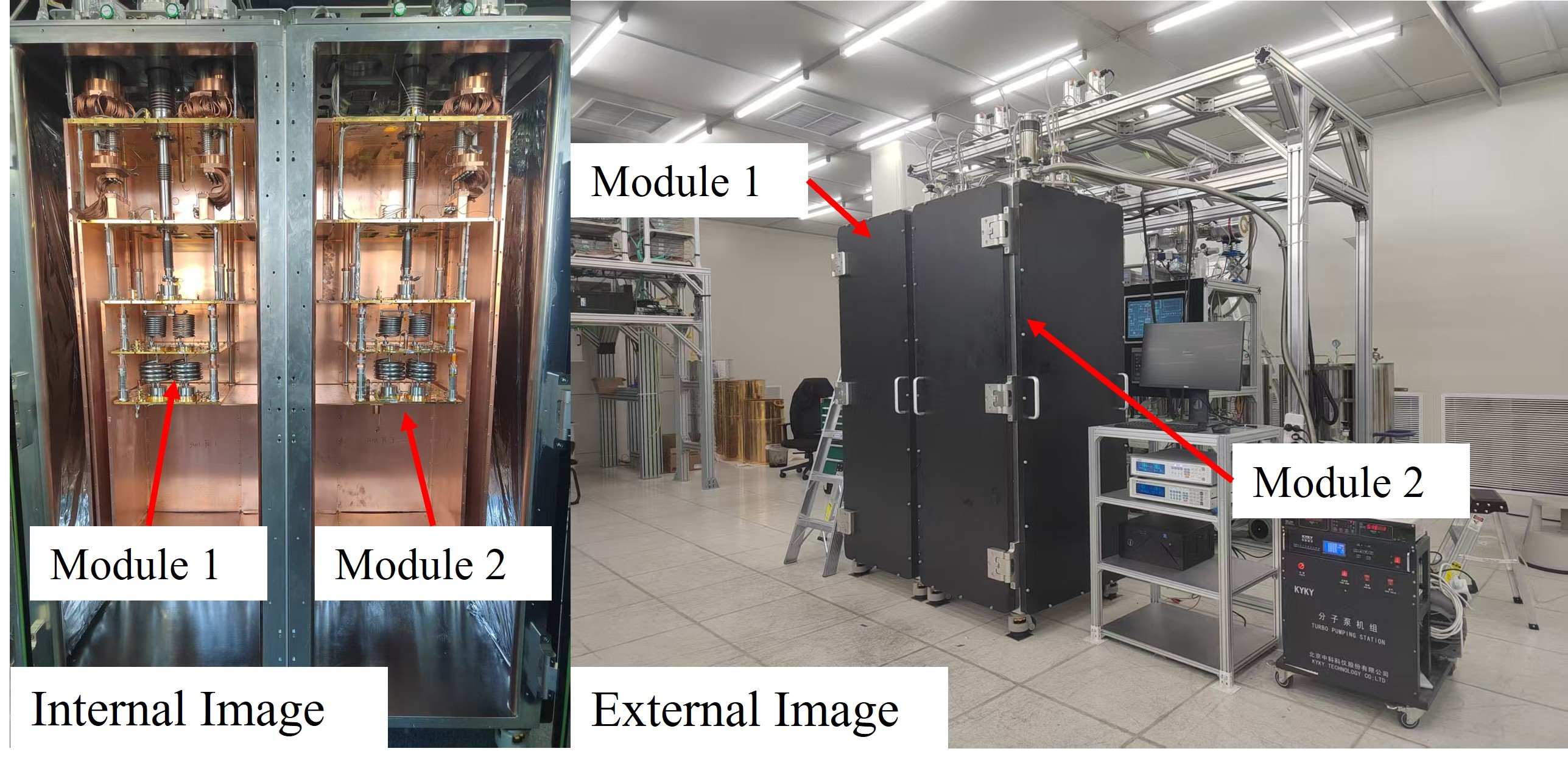
Photograph of the assembled modular dilution refrigerator.
Xiang Guan, Assistant Researcher in the Dilution Refrigerator Team, Quantum Computing Cloud Platform Department, BAQIS, is a co-first author and a corresponding author of this paper. Pei Liu, Assistant Researcher at BAQIS, is a co-first author. Researcher Zhongqing Ji of the Institute of Physics, CAS, and Researcher Haifeng Yu of BAQIS are co-corresponding authors. Coauthors also include Deming Wang, a PhD student at BAQIS; Senior Engineer Yuqun Xu; Researcher Yirong Jin; Jie Fan, Associate Researcher jointly appointed by BAQIS and the Institute of Physics, CAS; and Dr. Yongjie Xie of ZhongKe Quantum Instruments (Beijing) Tech Co., Ltd. This work was supported by the National Natural Science Foundation of China, the Quantum Science and Technology Innovation Program, the Beijing Municipal Science and Technology Program, BAQIS internal projects, and ZhongKe Quantum Instruments (Beijing) Tech Co., Ltd, among others.
Full-text link: https://journals.aps.org/prapplied/abstract/10.1103/lpcw-bm1q