 中文
 Email
 QCloud
 Log in


BAQIS and Collaborators Advance Quantum Compilation Benchmarking
2026/09/11
Researchers at the Beijing Academy of Quantum Information Sciences (BAQIS), in collaboration with the Institute of Computing Technology and the Institute of Physics of the Chinese Academy of Sciences (CAS), have developed a new framework for benchmarking quantum compilation. Named QROB (Quantum Realization Overhead Benchmark), the framework uses reverse construction to generate compilation test instances together with feasible reference solutions. It provides a new way to assess the additional costs incurred when mapping quantum programs onto hardware and to quantify the room for improvement in existing compilation tools.
The paper, “QROB: Quantifying Realization Overhead in Quantum Compilation via Reverse Construction,” has been accepted for presentation in the main program of the 59th IEEE/ACM International Symposium on Microarchitecture (MICRO 2026).
MICRO is a leading international conference in computer architecture. Together with ISCA, HPCA, and ASPLOS, it is widely recognized as one of the field’s four flagship conferences and is classified as a Category A conference by the China Computer Federation (CCF). Covering microarchitecture, compilation, and hardware–software co-design, MICRO provides a major forum for advances in computing systems. MICRO 2026 will take place in Athens, Greece, from October 31 to November 4, 2026.
How Much Room for Improvement Remains in Quantum Compilation?
Before a quantum algorithm can run on a physical processor, a quantum compiler must translate its operations into instructions that the hardware can execute. On many quantum chips, qubits can interact directly only with certain neighbors. Compilers must therefore insert additional operations to exchange quantum states or schedule operations around limited resources. These steps increase the number of quantum gates and the execution time, potentially reducing the reliability of the results. Similar challenges arise in fault-tolerant quantum computing, where compilers must place logical qubits, allocate interaction channels, and schedule their use.
Assessing how effectively a compiler handles these constraints is difficult. Finding an optimal compilation solution for a complex quantum circuit can be computationally prohibitive. Existing benchmarks can often identify which compiler performs better, but they offer limited insight into how far its output remains from a feasible solution with lower overhead.
QROB was developed to address this question.
Constructing Test Instances Backward from Known Feasible Solutions
The idea behind QROB can be illustrated by scrambling a Rubik’s Cube. Finding a solution to an arbitrary scramble can be difficult. Starting from a solved cube and recording each move used to scramble it, however, provides a known path back: reverse the recorded moves.
QROB follows a similar approach. It starts with quantum circuits that satisfy the target hardware constraints and can be executed directly. Controlled perturbations then produce compilation instances with varying structures and levels of difficulty, while the inverse operations are retained as feasible reference solutions. Each test instance therefore comes with a verifiable reference cost, avoiding the need for an expensive search after the instance has been generated.
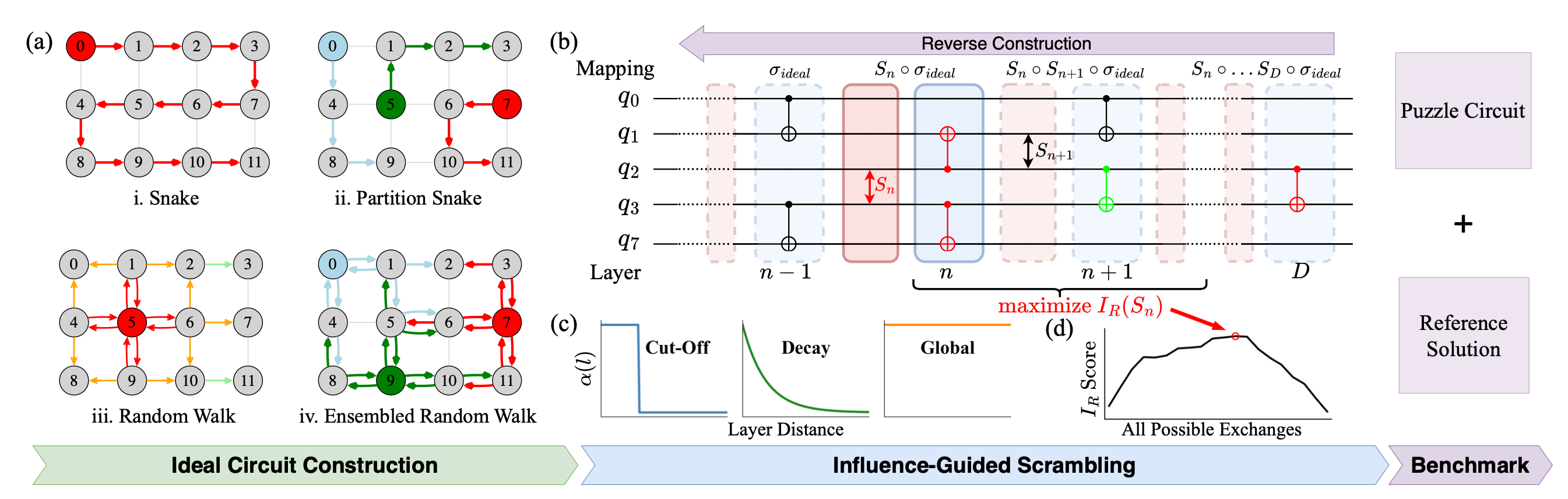
Figure 1. Overview of the QROB reverse-construction framework.
These reference solutions are independent of the compiler being evaluated, providing a clear basis for performance comparisons. The team assessed their quality using exact solvers on small instances and further examined the reference-generation approach through specially controlled constructions. For general instances, QROB retains the feasible solution generated alongside each test case, allowing different compilation methods to be evaluated against a known reference.
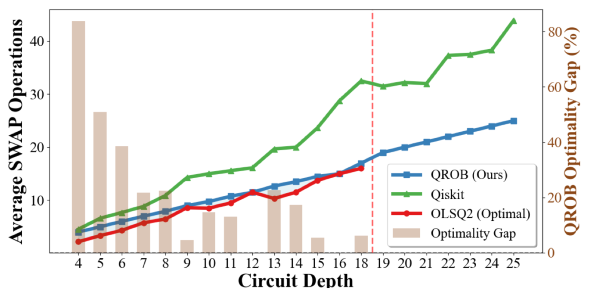
Figure 2. Comparison of QROB reference solutions with optimal solutions and solutions produced by SABRE.
The researchers applied this approach to qubit routing on near-term noisy quantum devices and lattice-surgery scheduling in fault-tolerant architectures. They also explored quantum memory-access scheduling when the compute region has limited capacity.
From Identifying Optimization Opportunities to Improving Compilation
Using these references, the team found that even widely used quantum compilation tools can incur substantial additional costs on some test tasks. On near-term noisy devices, restricted qubit connectivity can lead to many extra operations. In fault-tolerant architectures, resource conflicts can force operations that could otherwise run in parallel to execute sequentially, increasing both resource requirements and execution time.
These gaps became particularly apparent in larger-scale tests. The results indicate that significant opportunities remain to improve quantum compilation and make more effective use of quantum hardware.
The reference solutions also provide training data for AI-assisted quantum compilation. Such methods learn from examples how to organize quantum operations efficiently under hardware constraints, making the quality of their training data important to their performance. By retaining a reference solution for each generated circuit, QROB can supply training examples with explicit optimization targets.
The researchers found that models trained on QROB data improved compilation across several families of real application circuits, reducing the additional costs imposed by hardware constraints. This demonstrates the ability of the learned strategies to transfer beyond the generated training instances.
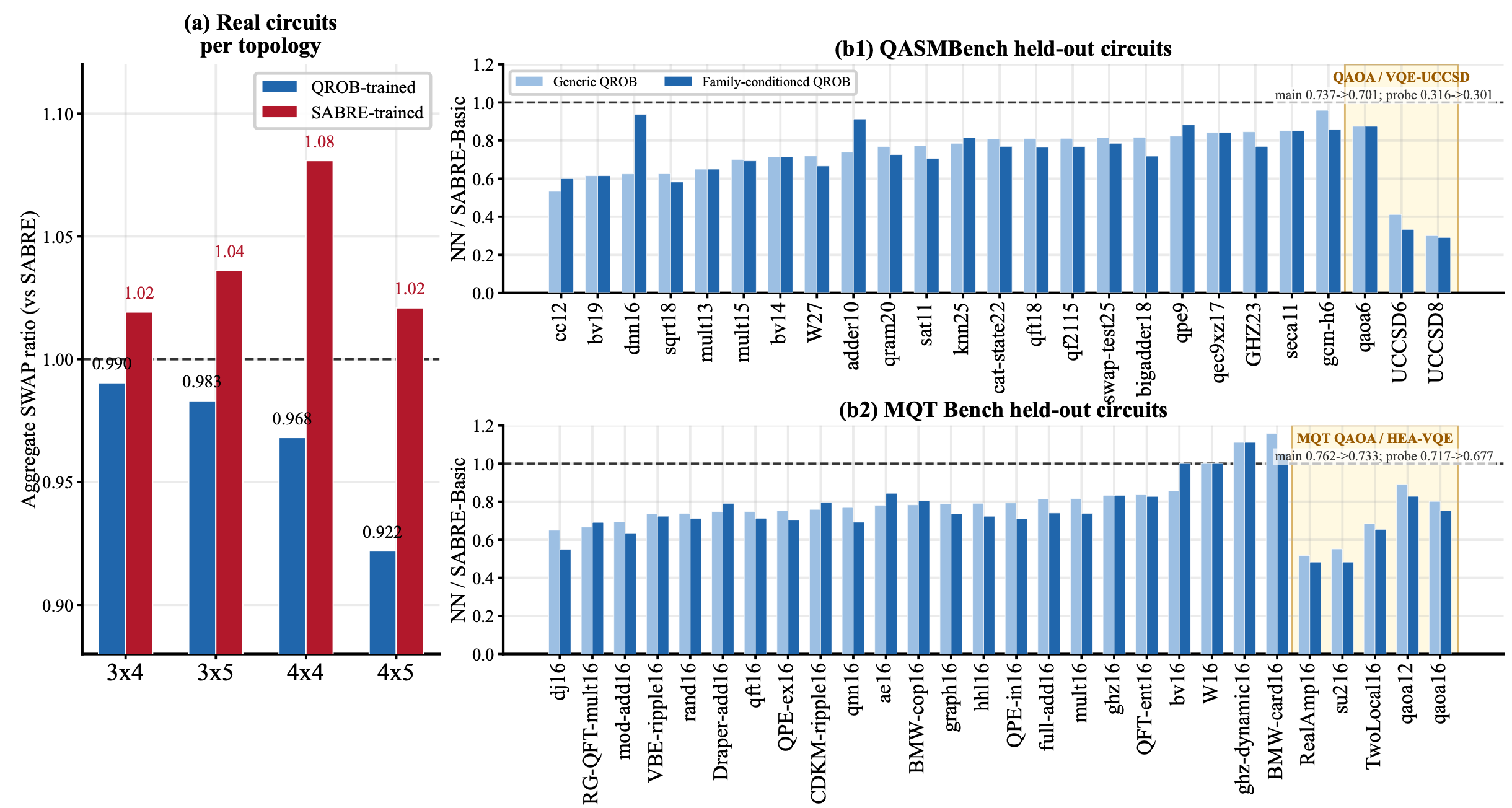
Figure 3. Comparison of QROB and SABRE datasets for training AI-assisted quantum compilers.
The team also conducted controlled experiments on three superconducting quantum computers. For the QROB-generated test circuits, using the QROB reference placement and routing improved execution quality compared with the full Qiskit O3 compilation pipeline. The probability of obtaining the expected result was approximately 65% higher at the median across paired comparisons.
These experiments show that the optimization opportunities identified by QROB can translate into measurable benefits on real quantum hardware.
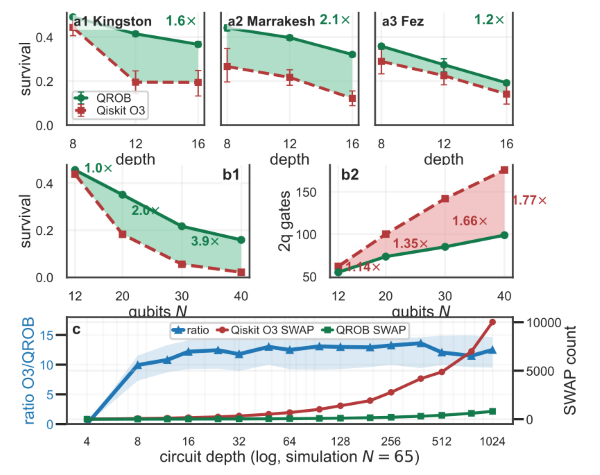
Figure 4. Comparison of QROB reference realizations and Qiskit O3 compilation on superconducting quantum computers.
By connecting compiler evaluation, training data generation, and experimental validation, QROB provides a quantitative basis for improving quantum compilation through hardware–software co-design. It also supports AI for Quantum by supplying high-quality training data and benchmarking references, helping AI models learn more effective compilation strategies and enabling their benefits to be tested on real hardware.
The first author of the paper is Jintao Li (BAQIS). The corresponding authors are Zheng-An Wang (BAQIS), Prof. Xiaoming Sun (ICT CAS), and Prof. Heng Fan (BAQIS / IOP CAS). The collaborators also include Kaixuan Huang (BAQIS), Kaiqi Li, Rui Wang, Yilun Zhao, Ying Wang, and Jialin Zhang (ICT CAS). This work was supported by the National Science and Technology Major Projects, the National Natural Science Foundation of China, and other programs.
Paper: https://arxiv.org/abs/2609.07776
Conference: https://www.microarch.org/micro59/