 中文
 Email
 QCloud
 Log in


BAQIS Demonstrates High-Quality Temporal-Mode Entanglement Using Quantum Dot Resonance Fluorescence
2026/10/29
Researchers from the Photonic Quantum Communication and Devices team at the Beijing Academy of Quantum Information Sciences (BAQIS) have demonstrated high-quality temporal-mode entanglement using resonance fluorescence from a single semiconductor quantum dot. Through simple linear optical beam splitting and postselection, the team generated entanglement and observed a significant violation of a Bell inequality. The findings were published in Optica on October 28, 2026, in a paper entitled “Bell inequality violation with vacuum–one-photon number superposition states.”
Photonic temporal-mode entanglement is an important resource for quantum communication and quantum information processing. Conventional approaches typically use nonlinear optical processes to generate correlated photon pairs. Increasing the excitation power, however, also increases the probability of emitting multiple pairs, which can degrade entanglement quality. Earlier studies proposed generating temporal-mode entanglement from photons emitted sequentially by a single-photon source, using linear optical operations and coincidence postselection. Limitations including photon indistinguishability had prevented a Bell inequality violation from being demonstrated in semiconductor quantum dot implementations of this approach.
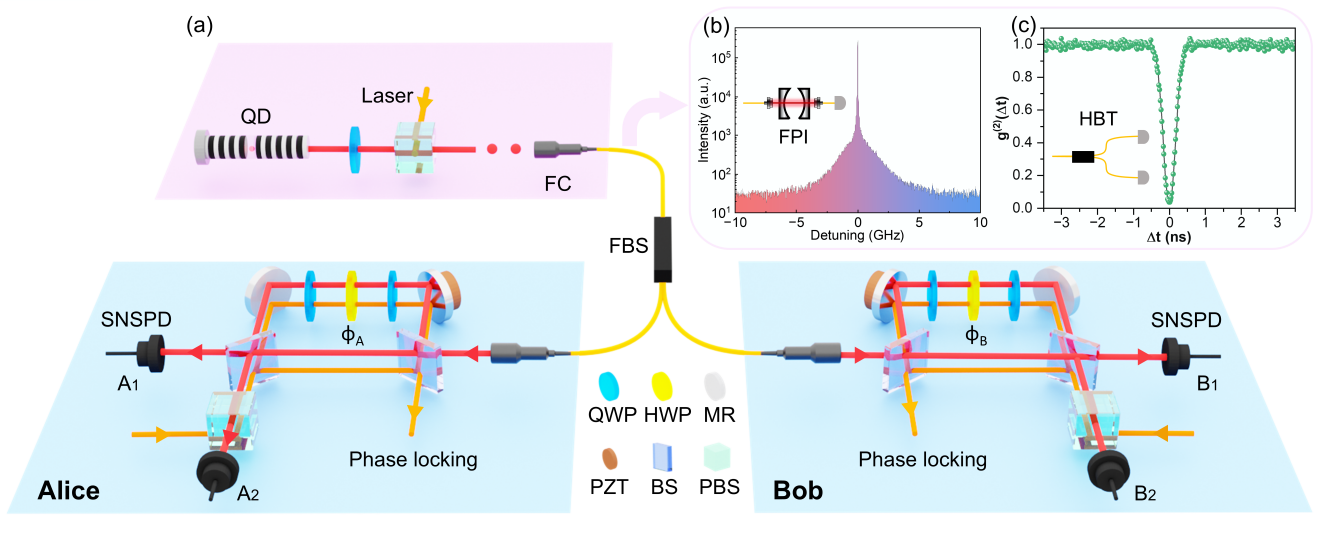
Figure 1. Experimental setup for generating temporal-mode entanglement using resonance fluorescence.
To address this challenge, the researchers used an indium arsenide (InAs) quantum dot coupled to a low-reflectivity micropillar cavity to generate single photons with high purity under continuous-wave resonant excitation. A beam splitter distributed the resonance fluorescence to two independent measurement stations, where unbalanced Mach–Zehnder interferometers enabled Franson two-photon interference measurements (Figure 1). The experiment achieved an average interference visibility of (92.8 ± 2.6)% and a Clauser–Horne–Shimony–Holt (CHSH) Bell parameter of S = 2.675 ± 0.050, exceeding the classical bound of S = 2 by more than 13 standard deviations (Figure 2). These results provide strong experimental evidence for postselected temporal-mode entanglement and agree closely with predictions from the pure-state model of resonance fluorescence previously developed by the team.
The work demonstrates a mechanism for generating temporal-mode entanglement without first producing photon pairs. In the ideal case, increasing brightness does not introduce the higher-order pair-emission events associated with conventional probabilistic photon-pair sources. Entanglement quality is primarily limited by single-photon purity and indistinguishability. The findings offer a new approach to preparing entangled states with solid-state single-photon sources and to developing future photonic quantum networks.
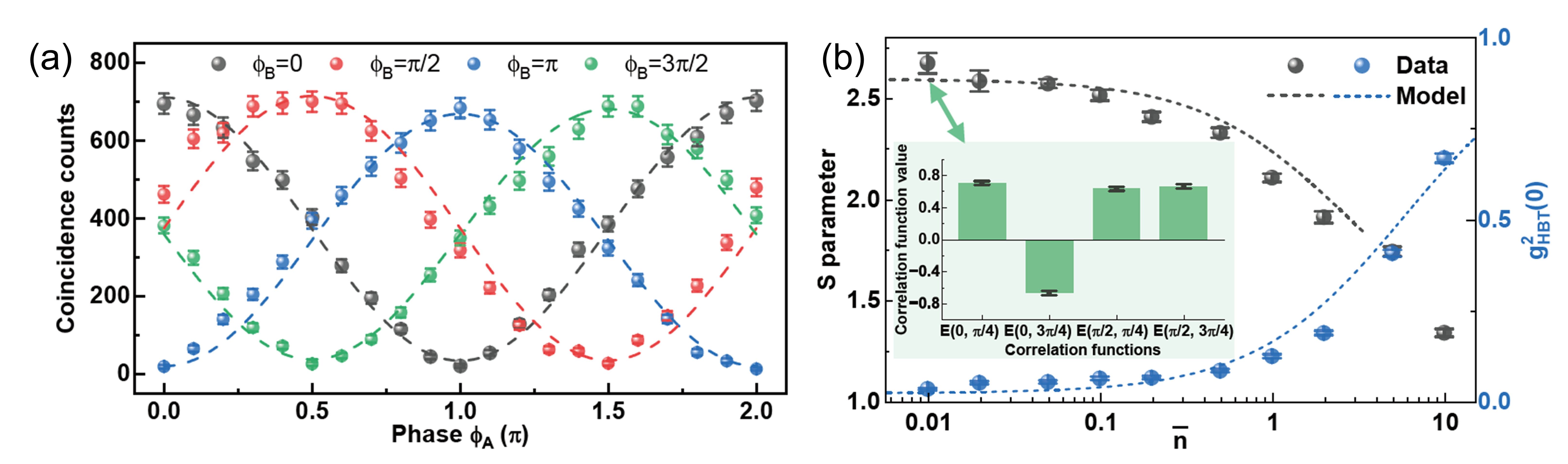
Figure 2. Franson interference fringes and the dependence of the CHSH Bell parameter on excitation intensity.
The co-first authors are Zi-Qi Zeng, a PhD student at BAQIS, and Jian Wang, an Assistant Research Scientist at BAQIS. The corresponding authors are Xu-Jie Wang, an Assistant Research Scientist, and Zhiliang Yuan, Chief Scientist, both at BAQIS. Other collaborators include Xiu-Bin Liu, a BAQIS intern and PhD student at Renmin University of China; Li Liu, a Senior Engineer, and Bang Wu, an Associate Research Scientist, at BAQIS; Hanqing Liu, a postdoctoral researcher, and research scientists Haiqiao Ni and Zhichuan Niu at the Institute of Semiconductors, Chinese Academy of Sciences; and Professor Carlos Antón-Solanas at the Autonomous University of Madrid, Spain.
The research was supported by the National Natural Science Foundation of China, the National Key Research and Development Program of China, and other funding programs.
Paper: https://doi.org/10.1364/OPTICA.601049
Research team: https://qp.baqis.ac.cn