 中文
中文 Email
Email QCloud
 Log in

Topological and Two-Dimensional Materials Group with Collaborator Achieved AFM-Lithium-induced Magentic-Structure Transition in 2D Fe3GaTe2
2026/07/17
Recently, Topological and Two-dimensional Materials Group from Beijing Academy of Quantum Information Sciences (BAQIS) successfully achieved in-situ controllable modulation of the magnetic structure of the room-temperature ferromagnet Fe3GaTe2 through gate-voltage-controlled lithium-ion intercalation by using solid lithium-ion conductor, revealing a prominent thickness dependence. The intrinsic cause of this thickness effect lies in the effective lithium-ion intercalation depth of approximately 20 nm. On July 3, 2026, the relevant research findings were published in Advanced Functional Materials under the title "Lithium-Induced Thickness-Dependent Magnetic Structure Transition in 2D Fe3GaTe2".
Two-dimensional (2D) magnetic materials have opened up new avenues for magnetoelectric coupling and spintronics research. Among them, the room-temperature 2D ferromagnet Fe3GaTe2 is considered a promising candidate for high-density information storage and spintronic devices, owing to its exceptional properties such as a high Curie temperature (~370 K), strong perpendicular magnetic anisotropy, and the ability to host skyrmion spin textures. However, achieving precise and non-volatile control over its ferromagnetic state remains a key bottleneck limiting its application. Solid-state lithium-ion intercalation, as an effective method for tuning carrier density and crystal structure, has induced various novel physical phenomena in systems like FeSe and CrGeTe3. Additionally, theoretical models also predict that lithium intercalation can induce antiferromagnetic interlayer coupling in thin-layer Fe3GaTe2. Nevertheless, experimental studies on the lithium-intercalation-based modulation of Fe3GaTe2 magnetism and its underlying microscopic mechanisms were previously unexamined.
Research indicates that lithium-ion intercalation can significantly alter the magnetic state of the material, with an effective intercalation depth of approximately 20 nm. Experimental results demonstrate that this modulation effect exhibits a strong thickness dependence (Fig. 1). For thin-layer samples of less than 20 nm thick, lithium ions tend to achieve full intercalation, leading to a marked reduction in coercive field accompanied by the formation of new ferromagnetic and antiferromagnetic states. For thicker samples above 20 nm, constrained by the intercalation depth limit, only partial intercalation along the vertical direction occurs, self-assembling into a vertical heterostructure of the intercalated and intrinsic region. This newly formed vertical structure increases the coercive field of thicker samples and induces an exchange bias effect. For instance, in a 60 nm-thick sample, lithium-ion injection causes the coercive field to increase significantly from approximately 0.3 T to around 1T, alongside a maximum observed exchange bias of about 0.3 T.
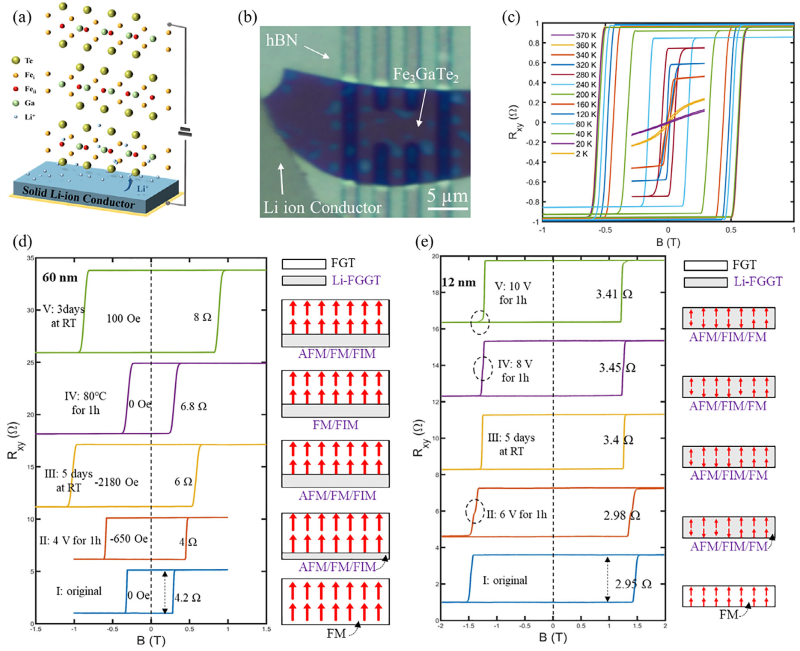
Figure 1. The lithium induced thickness-dependent magnetic-structure transition in 2D Fe3GaTe2. (a) Atomic structure of 2D Fe3GaTe2, showing the arrangement of Fe, Ga, and Te atoms within the crystal lattice. (b) Optical image of the 45 nm Fe3GaTe2 flake with hBN protection. (c) Temperature-dependent Hall resistance measurements of a 45 nm thick Fe3GaTe2 flake without lithium injection, demonstrating the material's electronic transport properties across various temperatures and high Curie temperature near 370 K. (d) Gate-tunable magnetic phase evolution in a 60 nm-thick Fe3GaTe2 flake with coexisting intercalated and non-intercalated regions, measured at 2 K. The schematic, Hall data, and exchange bias measurements demonstrate lithium diffusion and the gate-controlled proportion of FIM, AFM, and FM phases spatially confined to the Li-intercalated regions. (e) Gate-controlled magnetic phase evolution in a 12 nm-thick Fe3GaTe2 flake intercalated with Li, measured at 2 K. The schematic, Hall data, and extracted parameters demonstrate a gate-tunable ratio of FIM, AFM, and FM phases throughout the entire sample.
Fe3GaTe2 possesses room-temperature ferromagnetism and rich microscopic magnetic structures. Using Magnetic Force Microscopy (MFM), the research group observed in situ the evolution of magnetic domain structures in Fe3GaTe2 samples of varying thicknesses before and after lithium-ion injection at room temperature (Fig. 2), providing a direct microscopic physical picture to support the magnetotransport findings. For 40 nm- and 50 nm-thick samples, the magnetic domain structures underwent drastic changes following lithium-ion injection: the multi-domain structure in the 40 nm sample completely disappeared, transitioning into a single-domain state similar to that of thin-layer samples below 30 nm; meanwhile, the domains in the 50 nm sample partially disappeared, reflecting localized modifications. Furthermore, room-temperature resting (ion diffusion) and annealing treatments both produced significant shifts in the domain structures, demonstrating that both the injection and internal diffusion of lithium ions exert a potent modulation over the magnetic structure. For even thicker samples, no obvious changes in microscopic magnetic structure were observed after injection due to the limited penetration depth of the lithium ions. These MFM results confirm that lithium ions significantly modify the microscopic magnetic structure of thin-layer samples, with an effective intercalation depth inside thin-layer Fe3GaTe2 of approximately 20 nm—a microscopic magnetic insight highly consistent with the magneto-transport measurements.
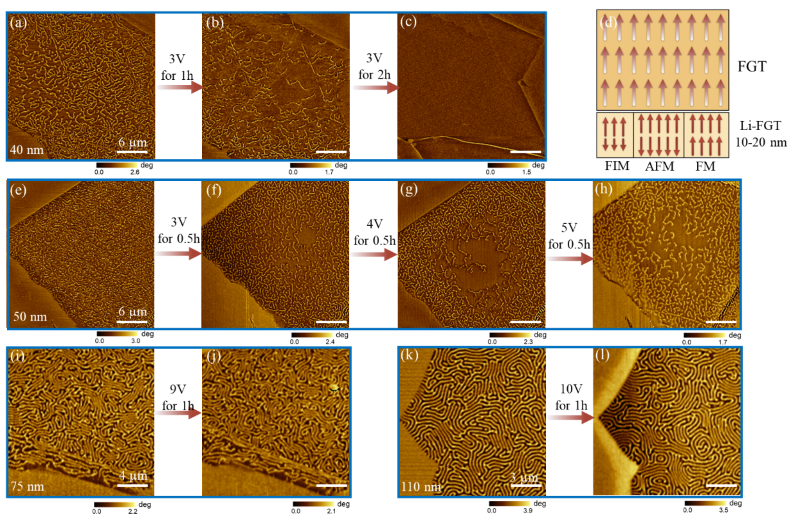
Figure 2. Room-temperature magnetic structure of Fe3GaTe2 flakes, obtained via MFM without an applied magnetic field, for different thicknesses (40 nm, 50 nm, 75 nm, 115 nm) under varying doping conditions. (a-c) Evolution of the magnetic structure upon lithium injection in 40 nm thick Fe3GaTe2 flakes, showing the formation of a large single magnetic domain. (d) Schematic of Li-intercalated magnetic Fe3GaTe2 with a tunable ratio of FIM, AFM, and FM phases under gating. (e-h) Evolution of the magnetic structure upon lithium injection in 50 nm thick Fe3GaTe2 flakes, revealing a significant transformation of the magnetic domain in the central region. (i-j, k-l) Evolution of the magnetic structure upon lithium injection in 75 nm and 110 nm thick Fe3GaTe2 flakes, with no significant changes observed in the magnetic structure for the thicker flakes. The scale bars in (a-c), (e-h), (i-j) and (k-l) are 6 μm, 6 μm, 4 μm and 3 μm, respectively.
The co-first authors of this paper are Junhai Ren (Assistant Researcher at BAQIS), Yufeng Gao (Ph.D. student at BAQIS) and Huiji Hu (Ph.D. student at the School of Physics, Renmin University of China). The corresponding authors are Katsumi Tanigaki (Chief Scientist at BAQIS), Junhai Ren (Assistant Researcher), Prof. Zhihai Cheng (School of Physics, Renmin University of China), and Assoc. Prof. Ping Li (School of Materials Science and Engineering, Xi'an Jiaotong University). Additional collaborators include Assoc. Researcher Zhilin Li (Institute of Physics, Chinese Academy of Sciences), Assoc. Researchers Liguo Zhang and Su Kong Chong, Assistant Researchers Huaxue Zhou and Chongli Yang (BAQIS), and Engineer Bo Bai (Guangdong Provincial Key Laboratory of Extreme Conditions). This research was supported by the National Natural Science Foundation of China, the National Key R&D Program of China, the Guangdong Provincial Key Laboratory of Extreme Conditions, the National Science and Technology Major Project, and the Beijing Natural Science Foundation.
Paper link:https://advanced.onlinelibrary.wiley.com/doi/10.1002/adfm.76783