 中文
中文 Email
Email QCloud
 Log in

Research Progress in Recharging-Induced Spin Dynamics of Electron-Rich NV Ensembles
2026/07/08
Recently, the Atomic Ensemble Precision Measurement Team of the Beijing Academy of Quantum Information Sciences (BAQIS) has made significant progress in research on charge-induced spin dynamics of electron-rich nitrogen-vacancy (NV) color center ensembles. The team experimentally observed charge-induced spin depolarization and spontaneous repolarization for the first time, uncovering the dominant mechanism of long-range defect-mediated electron transport. On July 6, 2026, the relevant findings were published in Physical Review B with the title “Recharging-induced spin depolarization and repolarization in electron-rich nitrogen-vacancy ensembles”.
The nitrogen-vacancy (NV) color center is a vital solid-state quantum defect in diamond. Owing to its spin-dependent photoluminescence properties, it has emerged as a prominent platform for quantum information processing and quantum sensing. In recent years, the sensitivity of quantum magnetic sensors based on NV color center ensembles has reached the level of 1 pT·Hz –1/2. Theoretically, higher NV color center density can further boost detection sensitivity. Nevertheless, high concentrations of nitrogen defects introduce abundant charge donors, triggering severe charge state fluctuations that constitute a undafmental bottleneck limiting practical device performance.
As a primary manifestation of charge state fluctuations, charge conversion between NV- and NV0 profoundly undermines the stability of spin polarization. Prior investigations into how charge conversion impacts spin polarization have mostly focused on single NV centers or optically excited conditions. By contrast, the intricate defect-mediated transport pathways governing NV spin polarization within high-density, electron-rich ensembles under dark conditions remain poorly understood and require systematic elucidation.
To clarify the underlying physical mechanism, the research team adopted Ib-type high-pressure high-temperature (HPHT) diamond samples. After high-energy electron beam irradiation and annealing treatment, uniformly distributed, moderately high-density NV color center ensembles were fabricated. To probe charging dynamics in the dark state, the team first implemented a T1 relaxation pulse sequence. By varying the dark interval after switching off the initialization laser, the evolution of fluorescence ratio as a function of dark time was systematically characterized. Furthermore, Rabi oscillation sequences were deployed to coherently drive transitions between the |0〉and |-1〉 spin sublevels. By adjusting the dark interval separating laser and microwave pulses, the team directly captured spin depolarization and repolarization behaviors occurring during dark periods.
The study reveals three distinct regimes of charge dynamic evolution under dark conditions, which depend on incident laser power. Firstly, under low laser irradiation power, charge conversion rapidly reaches equilibrium, and the fluorescence ratio decays monotonically exponentially, dominated primarily by spin-lattice relaxation. Secondly, under moderate laser power, polarization and ionization compete with each other. An abnormal fluorescence recovery (indicative of rapid NV0 → NV- recharging) emerges in the early stage of the dark interval, followed by longitudinal spin relaxation dominating the dynamics. In the third regime, under high laser power, charge dynamics govern the overall behavior entirely. The fluorescence ratio undergoes a full inversion, enabling extraction of the characteristic charging time constant.
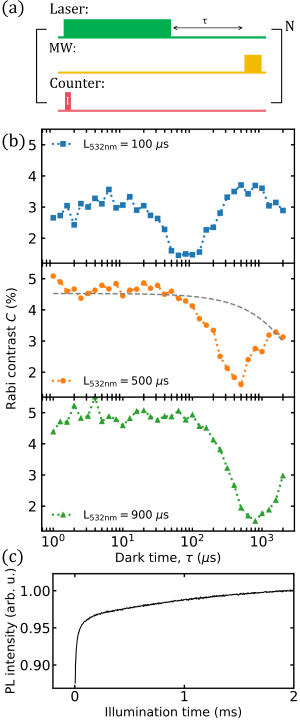
Figure 1. (a) Spin and charge manipulation pulse sequences adopted in this work. (b) Dynamic evolution of Rabi contrast as a function of excitation duration and laser dark interval. (c) Fluorescence intensity curves under continuous optical excitation.
Bi-exponential fitting analysis demonstrates that the charging time constant Tr is on the order of 10 microseconds and remains invariant against excitation intensity. Meanwhile, the spin relaxation time T1 is markedly perturbed at moderate laser power, illustrating the coupling effect of charging on spin polarization.
This work marks the first experimental observation of charge-induced spin depolarization and spontaneous repolarization. Rabi oscillation measurements uncovered an unexpected non-monotonic trend: after laser shutdown, the Rabi contrast remains nearly constant for short dark durations, subsequently drops to a minimum value, and recovers to nearly its initial level over extended dark intervals. This "collapse-and-recovery" signature matches the timescale of charging dynamics, and the recovery position can be tuned by adjusting the duration of the optical initialization pulse—longer initialization shifts the recovery point to longer dark times, as illustrated in Figure 1.
Quantitative analysis rules out direct NV-NV or NV-P1 tunneling mechanisms, identifying long-range defect-mediated electron transport as the dominant pathway. Nitrogen impurities function simultaneously as electron sources and storage reservoirs, forming a complex defect network. Electron hopping within this network follows reaction-diffusion dynamics rather than simple two-body tunneling.
Subsequently, photoluminescence spectroscopy combined with dual bandpass filters was utilized to separately monitor fluorescence signals from NV- and NV0, establishing a quantitative correlation between charge state population and counting rate ratio. Experiments confirm that stronger optical excitation generates a larger proportion of NV- centers. However, the increase in NV0 population during dark intervals cannot fully account for the observed contrast loss. Additionally, Rabi contrast curves acquired at three distinct excitation intensities exhibit nearly identical transition points, indicating that depolarization is governed by local electronic environments instead of the overall NV0 population fraction. Electron hopping between P1 color centers and NV defects—rather than direct NV-NV tunneling—dominates the dynamics of depolarization and subsequent repolarization.
For the first time, this study observes spin depolarization and spontaneous repolarization in electron-rich NV ensembles, and elucidates the recharging-induced effect as well as the long-range defect-mediated electron transport mechanism. It delivers a novel perspective for understanding charge-spin coupling within diamond defect networks. Optimizing initialization parameters delays the onset of spin depolarization to longer dark times, improving spin controllability in high-density NV ensembles. Moreover, these physical effects can be exploited for specialized applications such as polarization transfer to adjacent nuclear spins. Strategies including selective excitation via alternative laser wavelengths for direct charge-state monitoring and dynamical decoupling sequences are expected to further decouple charge and spin dynamics, paving the way for precise manipulation of NV color centers in disordered, strongly interacting environments.
The first author of the paper is Xianqi Dong, a PhD student at BAQIS. The corresponding authors are Associate Research Scientist Yan Liu and Research Scientist Renfu Yang(PI) from BAQIS. The other co-authors are Senior Engineer Chengliang Yue, PhD student Jiaqi Li, joint-training master’s student Xun Zhu, and Associate Research Scientist Xiaogang Wei. This research was supported by the Beijing Natural Science Foundation.
Paper link: https://doi.org/10.1103/1f4n-fln4