 中文
中文 Email
Email QCloud
 Log in

AI Quantum Group Reports Progress in Observing and Modulating the Quantum Mpemba Effect on a Superconducting Quantum Processor
2026/07/01
Recently, the AI Quantum Group at the Beijing Academy of Quantum Information Sciences (BAQIS), together with the Institute of Physics, Chinese Academy of Sciences and other collaborators, achieved the observation and multi-dimensional modulation of the quantum Mpemba effect (QME) in an isolated quantum system on a superconducting quantum processor. Using a superconducting chip with an all-to-all connected architecture and tunable Hamiltonian parameters, the team systematically examined how interaction range, on-site potential, and initial-state choice govern the QME, providing a programmable experimental platform for understanding and controlling non-equilibrium dynamics in quantum many-body systems. On June 29, 2026, the work, titled Observation and Modulation of the Quantum Mpemba Effect on a Superconducting Quantum Processor, was published in Physical Review Letters and selected as an Editors' Suggestion.
The Mpemba effect originated from the counterintuitive observation in classical systems that, under certain conditions, initially hotter water can freeze faster. In recent years, this idea has been extended to the quantum regime. In certain non-equilibrium quantum many-body systems, a subsystem with stronger initial symmetry breaking may restore the symmetry faster, giving rise to the quantum Mpemba effect. The effect offers a distinctive window into quantum thermalization, ergodicity breaking, and symmetry-restoration dynamics, and it may also inspire quantum-information tasks such as efficient state preparation and qubit reset. Until now, however, research on the QME has remained largely theoretical, and flexible experimental control of the effect has been limited.
To address this challenge, the team designed and fabricated a 16-qubit superconducting quantum processor (Figure 1). The chip integrates 16 tunable couplers and a frequency-adjustable central bus resonator, enabling separate control of nearest-neighbor short-range interactions and long-range interactions and allowing the system to switch continuously between different coupling regimes. In the experiment, 14 adjacent qubits were selected to form a quantum spin chain. Through precise frequency control, pulse calibration, and initial-state preparation, the researchers achieved joint control over the system Hamiltonian, on-site potentials, and the degree of initial symmetry breaking.
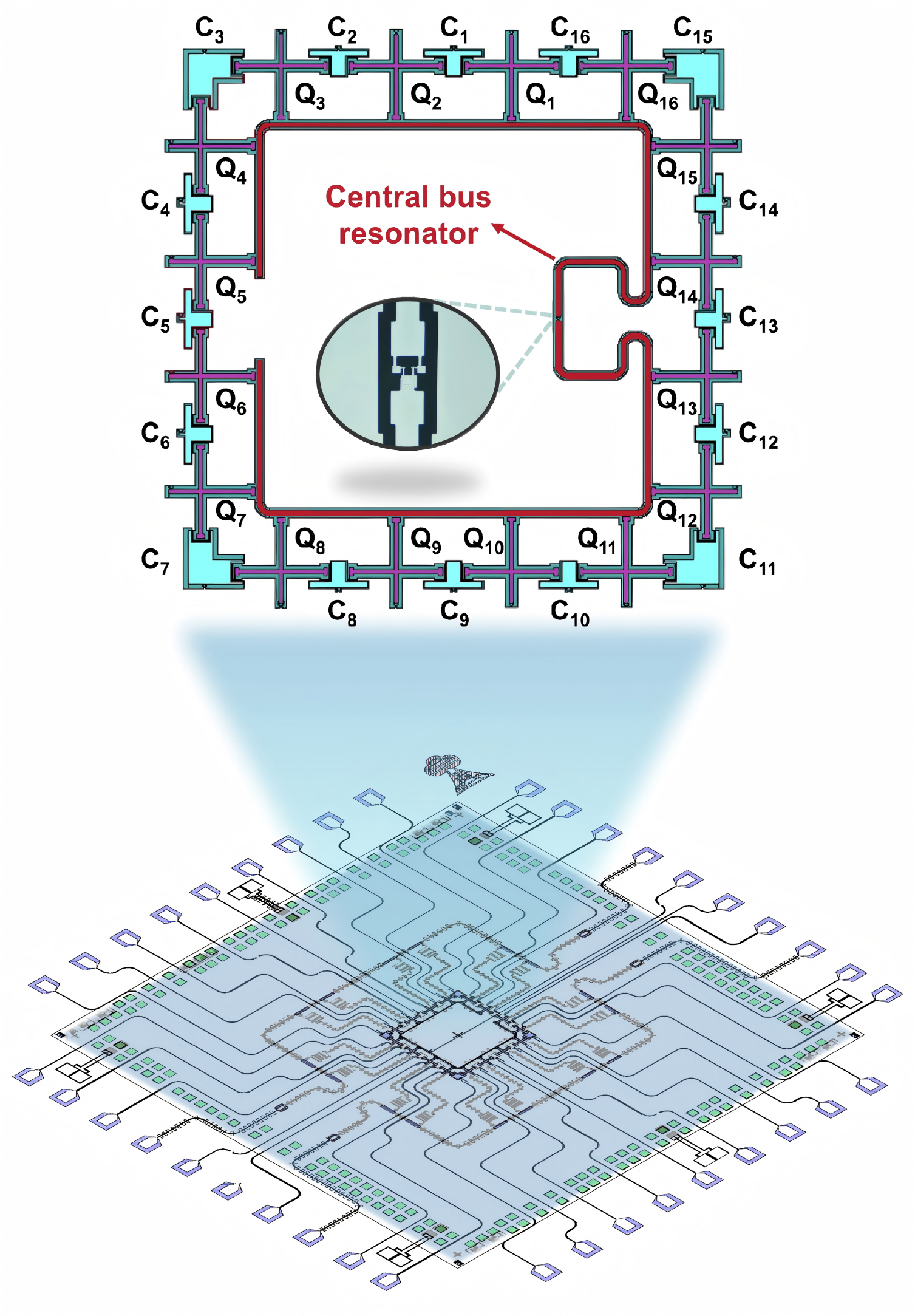
Figure 1. Superconducting quantum processor with an all-to-all connected architecture and tunable Hamiltonian parameters.
To characterize the QME, the researchers employed entanglement asymmetry (EA) as a sensitive probe of symmetry breaking and symmetry restoration. Experimentally, they reconstructed the density matrix of a three-qubit subsystem via quantum state tomography and calculated the time evolution of EA through classical post-processing. Compared with conventional entanglement entropy, EA more directly captures quantum coherences between different charge sectors and therefore tracks how U(1) symmetry is restored during non-equilibrium evolution.
The team first performed quantum-quench experiments from tilted Néel initial states in the strong short-range coupling regime. This regime is close to an integrable limit, where the early-time dynamics are still mainly governed by quasiparticle propagation. The results show that states with stronger initial symmetry breaking restore the symmetry faster and display a clear dynamical crossover with states that have weaker initial symmetry breaking, marking the emergence of the QME (Figure 2a). When the long-range coupling was increased until it became comparable to the nearest-neighbor coupling, the early-time dynamics of tilted Néel states became dominated by thermalization; the EA crossover disappeared, indicating suppression of the QME (Figure 2b). By introducing a site-dependent on-site linear potential, the researchers weakened ergodicity and suppressed thermalization, causing the EA crossover that had vanished in the intermediate-coupling regime to reappear (Figure 2c).
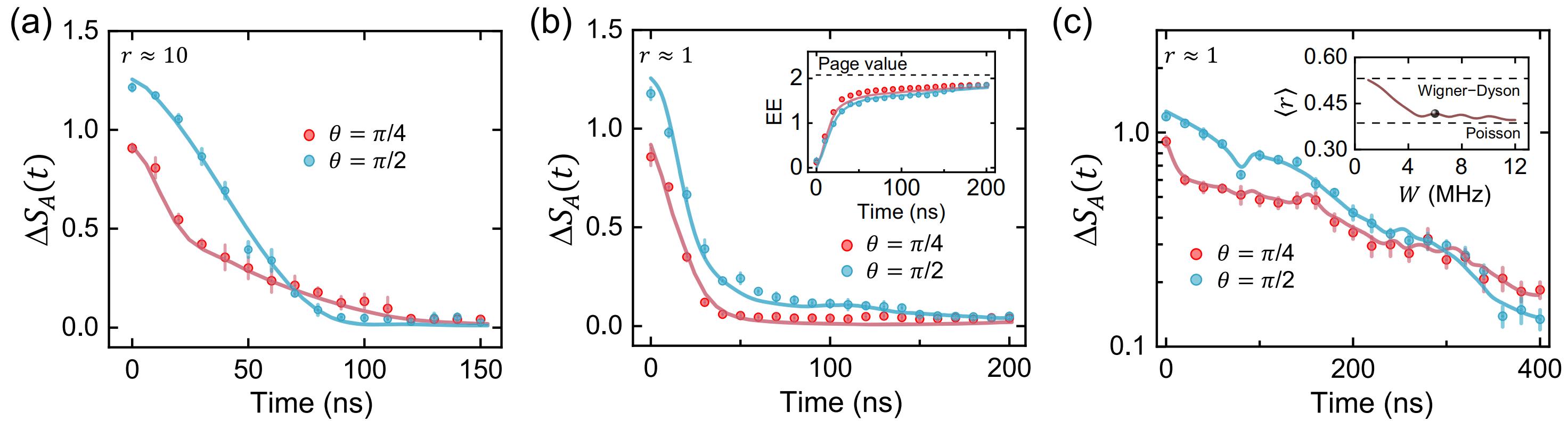
Figure 2. Entanglement-asymmetry dynamics of tilted Néel states under different control parameters.
This study advances the QME from the observation of a single phenomenon to an experimental investigation of multidimensionally controllable dynamics. By tuning the ratio between short- and long-range interactions, introducing on-site potentials, and selecting different initial states, the researchers realized the emergence, suppression, and reemergence of the QME (Figure 3b). The work establishes a programmable superconducting platform for further exploring symmetry restoration, thermalization processes, and ergodicity breaking in non-equilibrium quantum many-body systems. Looking ahead, this direction may be extended to prethermal dynamics, systems with different symmetries, and entanglement asymmetry under symmetry-breaking Hamiltonians, while also offering new physical ideas for quantum state preparation and qubit reset.
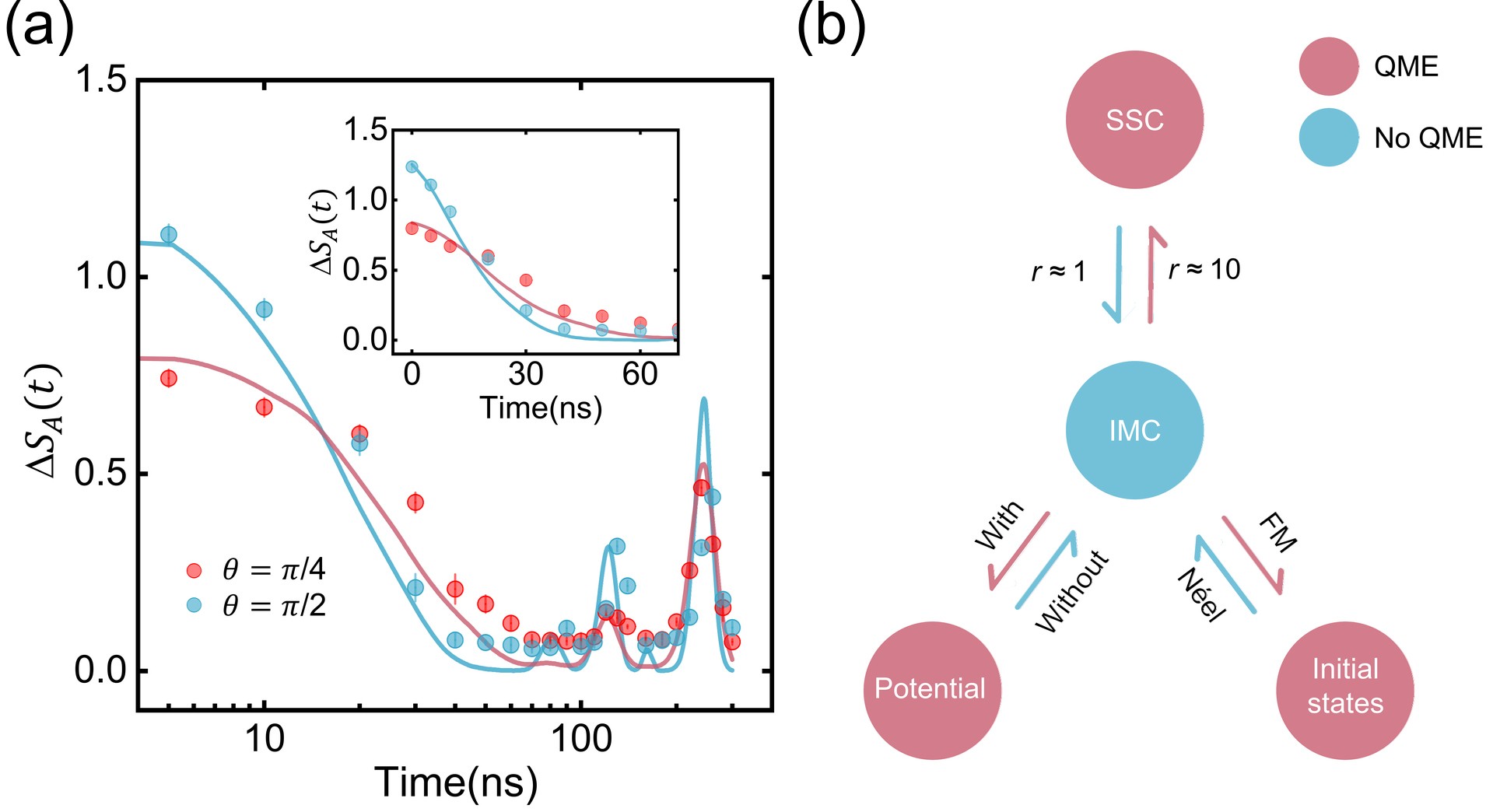
Figure 3. Entanglement-asymmetry dynamics of tilted ferromagnetic states in the LMG model and multidimensional modulation of the QME.
The co-first authors of the paper are Yueshan Xu, former BAQIS postdoctoral fellow, and Cai-Ping Fang, Bing-Jie Chen, and Ming-Chuan Wang, Ph.D. students at the Institute of Physics, Chinese Academy of Sciences. The corresponding authors are Kaixuan Huang, Assistant Research Fellow at BAQIS; Zhongcheng Xiang, Associate Senior Engineer at the Institute of Physics, Chinese Academy of Sciences; Kai Xu, Associate Research Fellow at the Institute of Physics, Chinese Academy of Sciences; and Heng Fan, BAQIS adjunct researcher and researcher at the Institute of Physics, Chinese Academy of Sciences. The collaborators also include Zi-Yong Ge, postdoctoral fellow at RIKEN; Dongning Zheng and Gangqin Liu, researchers at the Institute of Physics, Chinese Academy of Sciences; Shi-Xin Zhang, Special Research Fellow; Associate Research Fellows Xiaohui Song and Ye Tian; postdoctoral fellows Yun-Hao Shi, Yu Liu, and Gui-Han Liang; Ph.D. students Zheng-He Liu, Tian-Ming Li, Da'er Feng, Xu-Yang Gu, Yang He, Hao-Tian Liu, Zheng-Yang Mei, Yongxi Xiao, Yi-Han Yu, Wei-Ping Yuan, and Jia-Chi Zhang; Professor Yu-Ran Zhang from South China University of Technology; Ph.D. student Yu Yan from Northwest University; BAQIS Assistant Research Fellows Cheng-Lin Deng, Xue-Yi Guo, and Zheng-An Wang; BAQIS Senior Engineer Kui Zhao; and former BAQIS postdoctoral fellows Hao Li and Ziting Wang.
The authors thank Zheng-Hang Sun, a postdoctoral fellow at the University of Augsburg, for helpful theoretical discussions. This work was supported by the National Natural Science Foundation of China, the Innovation Program for Quantum Science and Technology, the Beijing High-level Innovative and Entrepreneurial Talent Support Plan-Fundamental Research Talent Program, the Beijing Nova Program, the Open Research Fund Program of the Beijing National Laboratory for Condensed Matter Physics, the Young Elite Scientists Sponsorship Program of the Beijing High Innovation Plan, and the Beijing Natural Science Foundation.
Original Article Link: https://journals.aps.org/prl/abstract/10.1103/951q-j8kq