 中文
中文 Email
Email QCloud
 Log in

Quantum Measurement and Manipulation of Coherent Atomic System Group Advances Continuous Native-Gate Quantum Circuit Synthesis with Generative AI
2026/05/25
Recently, the Quantum Measurement and Manipulation of Coherent Atomic System Group at Beijing Academy of Quantum Information Sciences (BAQIS) made progress in the optimized generation of continuous native-gate quantum circuits using generative AI. On May 21, 2026, the related results were published in Physica Scripta under the title “Hybrid diffusion-optimization for quantum synthesis with continuous native gates.”
In quantum computing, mapping a given target unitary matrix into a quantum circuit that can be directly executed on hardware is an important task. This process is commonly known as quantum circuit synthesis: generating the corresponding sequence of quantum gates according to a target quantum operation, so that it can be run on specific quantum hardware. As the number of qubits increases, conventional search- and gradient-optimization-based methods face rapidly rising computational complexity, while the diversity of native gate sets across hardware platforms further increases the difficulty of circuit generation. To address this challenge, the research team introduced a generative AI model to explore a new route for efficient quantum circuit generation by learning the relationship between quantum-circuit structures and continuous parameters.
The hybrid diffusion-optimization framework developed by the team combines a denoising diffusion probabilistic model (DDPM) with lightweight gradient post-optimization for the generation and fine-tuning of continuous native-gate quantum circuits (Fig. 1). In this method, a quantum circuit is first encoded as a fixed-shape tensor representation, in which gate types and continuous parameters are represented by different channels. The target unitary operation is transformed into conditioning information by a dedicated unitary-matrix encoder, which guides the diffusion model to generate the corresponding circuit. Under the conditional input, the DDPM then gradually transforms initial random noise into a complete quantum-circuit representation, identifies gate types through cosine similarity, and reads out the corresponding continuous parameters from the tensor channels. After generation, a gradient-optimization stage further adjusts the continuous parameters to reduce random deviations and improve circuit accuracy.
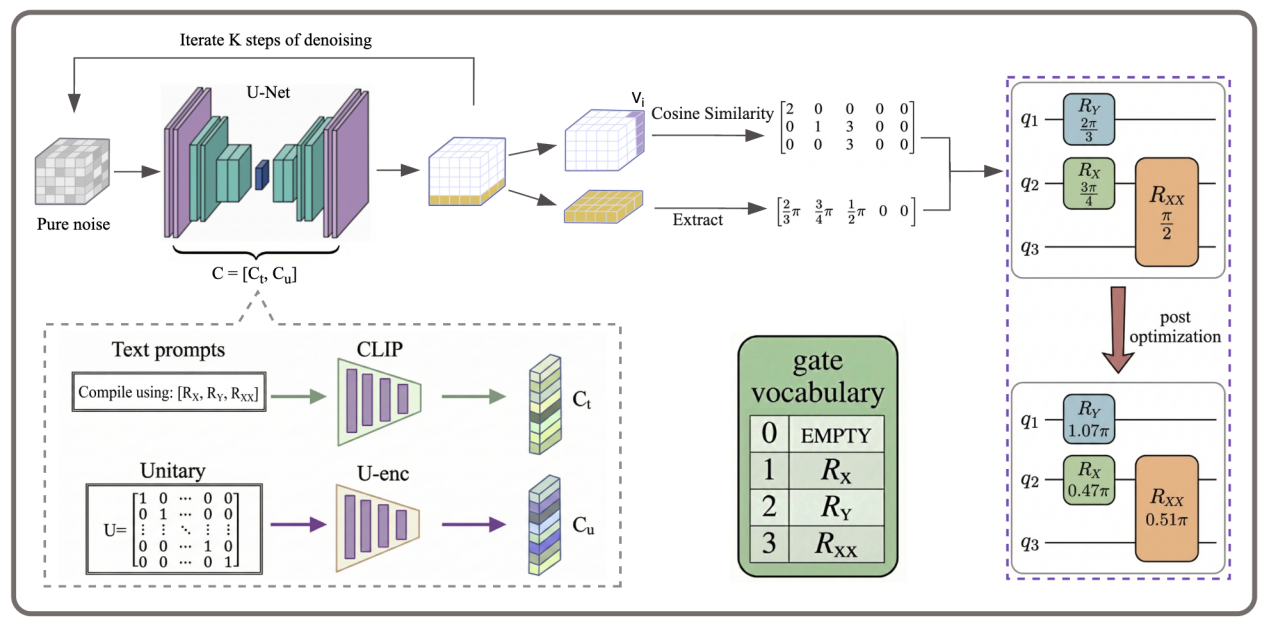
Figure 1. Schematic of the hybrid diffusion-optimization workflow.
To validate the effectiveness of the method, the team systematically tested 10,000 randomly generated three-qubit target unitary matrices. For each target, 500 candidate circuits were generated, and the agreement between each circuit and the target operation was evaluated by calculating the process infidelity. The results show that the framework can generate quantum circuits that closely approximate the target operations. After validation, the team further analyzed the structural features and parameter distributions of the generated circuits. The conditional parameter-distribution heatmaps (Fig. 2) show that the model can learn the distribution patterns of continuous parameters under different gate types and exhibits diverse generation modes. These results indicate that the hybrid diffusion-optimization framework can capture complex structure–parameter dependencies in continuous parameter space, providing reliable priors for quantum circuit generation without relying on a specific hardware platform or a discretized gate set.
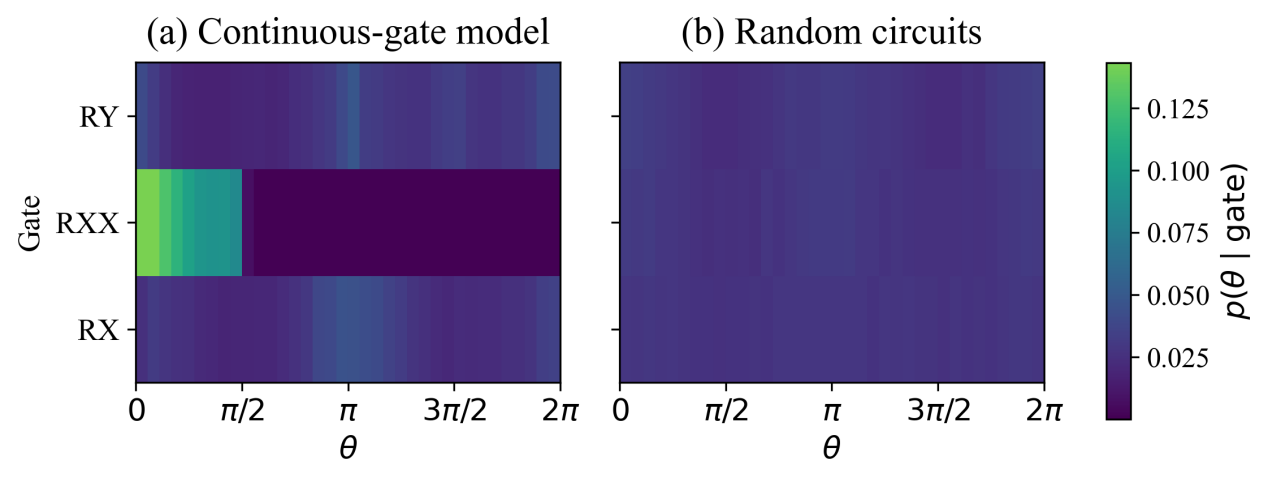
Figure 2. Conditional parameter-distribution heatmap of the continuous native-gate quantum-circuit generation model.
This work closely integrates generative AI models with continuous native-gate quantum circuit synthesis, forming a transferable hybrid diffusion-optimization framework. The method not only generates compact and executable quantum circuits, but also offers a new perspective for quantum–classical co-designed experimental workflows: AI models can serve as intelligent assistant tools to help researchers rapidly construct and optimize quantum circuits corresponding to target unitary operations and adapt them to the native gate sets of different hardware platforms. This fully demonstrates the potential of “AI for Quantum” in quantum information processing. The method can be extended to more qubits and more complex hardware-native gates, providing strong support for the efficient deployment of future quantum algorithms and their adaptation to quantum hardware.
The first author of the paper is Dajun Guo, an intern at BAQIS, and the corresponding author is Xiaolu Su, an Assistant Researcher at BAQIS. The collaborators also include Chukun Hu from Tsinghua University. This work was supported by the National Natural Science Foundation of China.
Article link: https://iopscience.iop.org/article/10.1088/1402-4896/ae6a4a
- Quantum Operating System Software Group Reports Significant Progress in Neutral-Atom Quantum Compilation
- The High-Temperature Superconductivity Group and the Low-Dimensional Quantum Materials Group Together with Collaborators, Have Made Progress in the Study of Quantum Phase Transitions in Superconducting States