 中文
中文 Email
Email QCloud
 Log in

The High-Temperature Superconductivity Group and the Low-Dimensional Quantum Materials Group Together with Collaborators, Have Made Progress in the Study of Quantum Phase Transitions in Superconducting States
2026/05/13
Recently, the high-temperature superconductivity group and the low-dimensional quantum materials group at the Beijing Academy of Quantum Information Sciences (BAQIS), in collaboration with Tsinghua University, University of Geneva, Beijing Normal University, and National Institute for Materials Science, observed a magnetic-field-induced first-order quantum phase transition within a dissipationless state in multilayer Ising superconductors. This provides key experimental evidence for a novel finite-momentum pairing state. On May 12, 2026, the results were published in Nature Communications under the title “Spectroscopic evidence for a first-order transition to a possible orbital Fulde-Ferrell-Larkin-Ovchinnikov state.”
In the classical BCS theory, electrons in a superconductor form Cooper pairs, with each pair having zero total momentum. In the 1960s, Fulde, Ferrell, Larkin, and Ovchinnikov proposed that, under Zeeman splitting induced by a magnetic field, the Cooper pairs could lower their energy by pairing with nonzero total momentum. The resulting dissipationless state later became known as the FFLO state. The transition from zero-momentum pairing to finite-momentum pairing typically corresponds to a first-order quantum phase transition. In recent years, theorists further predicted that, in multilayer Ising superconductors, the orbital effect of a magnetic field could induce a new type of finite-momentum pairing state, known as the orbital FFLO state. Temperature-dependent critical magnetic field behaviors that are consistent with expectations for the orbital FFLO state have been observed in a series of layered superconductors with strong spin-orbit coupling. However, confirming the existence of the orbital FFLO state requires direct observation of the first-order transition from the zero-momentum state to the finite-momentum state, posing extremely demanding experimental requirements.
In the latest study, the research team fabricated high-quality van der Waals tunneling junctions and achieved highly precise alignment between the magnetic field and the crystal planes of the multilayer Ising superconductor. They observed the evolution of the superconducting tunneling spectrum under a parallel magnetic field and discovered discontinuity and hysteresis in the superconducting energy gap value at a certain magnetic field strength—hallmark signatures of a first-order phase transition (Figure 1). The team also found that this first-order phase transition occurs only when the applied magnetic field is almost perfectly aligned with the material’s two-dimensional crystal plane and is highly sensitive to sample quality. These characteristics are all consistent with theoretical expectations for the orbital FFLO state. As the thickness increases, the magnetic field strength required to induce the first-order phase transition decreases rapidly. To understand the experimentally obtained phase diagrams, the researchers extended a theory previously proposed for bilayer Ising superconductors to multilayer systems. They analyzed and established the finite-momentum distributions in multilayer structures and calculated phase diagrams consistent with experimental observations (Figure 2). This work demonstrates that tunneling spectroscopy is a highly sensitive probe for studying novel quantum states in mesoscopic-scale samples and can be used to investigate quantum phases in layered superconductors.
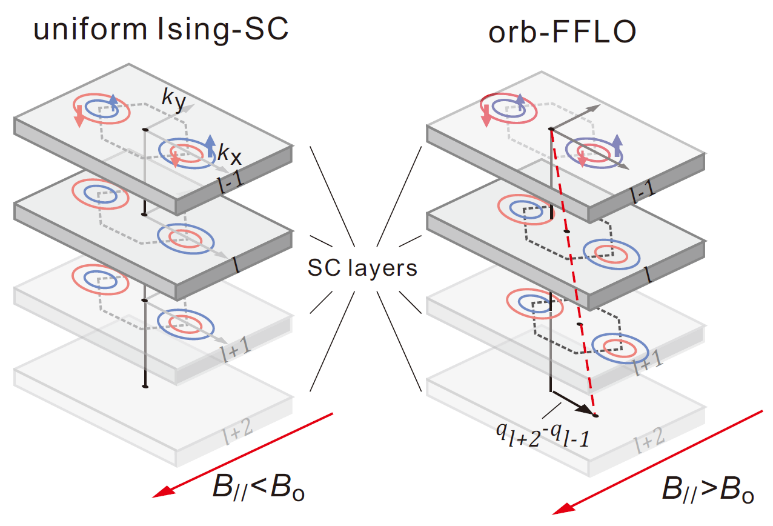
Figure 1: Schematic diagrams of the zero-momentum pairing state (left) and finite-momentum pairing state (right) in multilayer Ising superconductors.
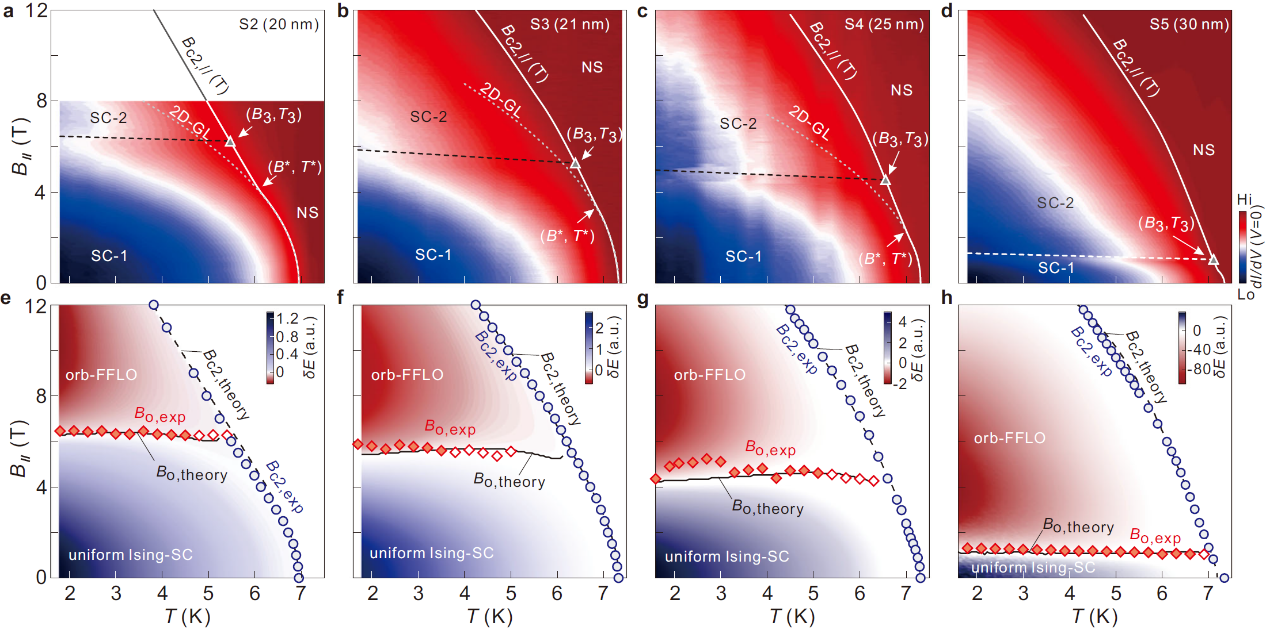
Figure 2: Experimental and theoretical phase diagrams for samples of different thicknesses.
The co-first authors of the paper are Zongzheng Cao, Menghan Liao, and Hongyi Yan. The corresponding authors are Menghan Liao, Haiwen Liu, and Ding Zhang. Other collaborators include Yuying Zhu, Liguo Zhang, and Qikun-Xue. This work was supported by the National Key Research and Development Program of China, the National Natural Science Foundation of China, and other funding programs.
Article link:https://www.nature.com/articles/s41467-026-72134-z