 中文
中文 Email
Email QCloud
 Log in

Quantum Operating System Software Group Reports Significant Progress in Neutral-Atom Quantum Compilation
2026/05/27
Recently, the Quantum Operating System Software R&D Team at the Beijing Academy of Quantum Information Sciences (BAQIS) proposed ZAP, a zoned architecture and high-performance compiler for field-programmable atom arrays. Through hardware-architecture and compiler-algorithm co-design, the work addresses key tensions among logical-circuit mapping, atom transport, crosstalk control, and compilation efficiency in neutral-atom quantum computing, and provides a new software-stack solution for fast, scalable, and noise-aware neutral-atom quantum computation. On May 25, 2026, the work was published in IEEE Transactions on Quantum Engineering under the title “ZAP: Zoned Architecture and Performant Compiler for Field Programmable Atom Array.”
In neutral-atom quantum computing platforms, qubits are carried by individual atoms trapped in optical tweezers. Unlike fixed-connectivity qubit architectures, neutral-atom platforms allow atoms to be dynamically moved and rearranged during computation, so qubits that are originally far apart can be brought close together when a two-qubit gate is required. This capability offers flexible connectivity for large-scale quantum computing and avoids much of the SWAP-gate overhead introduced by fixed hardware topologies.
Dynamic reconfigurability, however, also creates new compilation challenges. A compiler must determine not only which physical atoms should host the logical qubits, but also when atoms should move, where they should move, how multiple movements can proceed in parallel, and how path conflicts under acousto-optic deflector (AOD) control constraints can be avoided. Meanwhile, two-qubit gates are typically implemented through Rydberg excitation in designated regions; idle qubits exposed to the relevant laser fields may suffer additional crosstalk. As the number of qubits and circuit size increase, the search space of atom placement and transport routes expands rapidly, and existing compilation methods based on repeated global search can become a new system-level bottleneck.
To address these issues, ZAP first introduces a zoned architecture at the hardware level, dividing the neutral-atom array into a storage zone and an entanglement zone. The storage zone holds qubits that are not currently involved in two-qubit operations, while the entanglement zone is used for executing entangling gates. By spatially separating the functions of idling and entanglement, ZAP reduces the chance that idle qubits are affected by the global laser fields used for two-qubit gates, mitigates crosstalk, and provides clearer physical constraints for subsequent compiler design.
On the compilation side, ZAP adopts a deterministic, single-pass flow tailored to the zoned architecture. The flow includes hardware-aware ASAP-separate scheduling, look-ahead qubit placement, and conflict-aware routing. In contrast to conventional ASAP scheduling, which primarily attempts to compress logical circuit depth, ZAP first organizes two-qubit operations and then fills single-qubit operations into suitable temporal slots. This strategy reduces frequent back-and-forth atom transport caused by interleaved execution. During placement and routing, ZAP anticipates future qubit reuse from the downstream circuit structure and, together with AOD row and column constraints, selects movement plans that are more amenable to parallel execution. Figure 1 illustrates the difference in atom transport between ASAP-joint and ASAP-separate across consecutive logical stages.
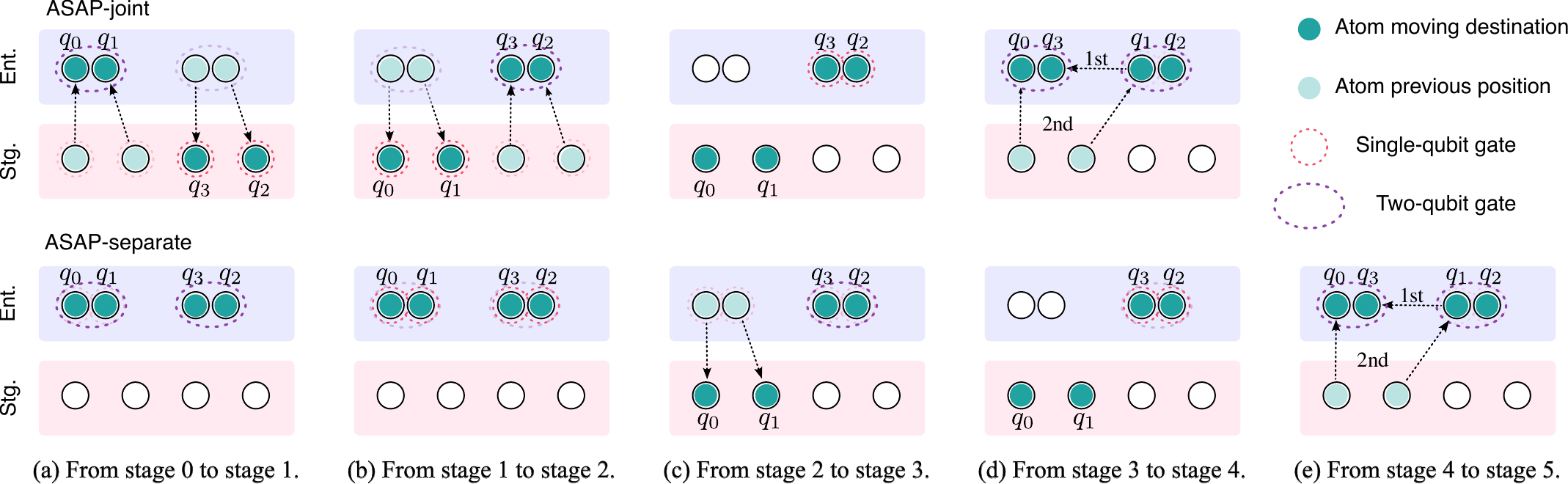
Figure 1. Atom transport comparison between ASAP-joint and the ASAP-separate strategy adopted by ZAP across consecutive logical stages. The top row shows ASAP-joint, and the bottom row shows ASAP-separate; dashed arrows indicate atom transport.
In addition, for qubits that are already in the entanglement zone but are temporarily idle in the current stage, ZAP does not rigidly adopt either an “always return to storage” or an “always stay in the entanglement zone” policy. Instead, it dynamically compares the predicted crosstalk loss from staying in place with the transport and decoherence losses caused by moving, and then decides whether the qubit should be moved. This look-ahead management allows ZAP to strike a balance between suppressing crosstalk and avoiding unnecessary atom transport.
The research team systematically evaluated ZAP on a range of structured quantum-algorithm benchmark circuits and random 3-regular circuits, comparing it with representative international neutral-atom compilers including Enola, ZAC, and PowerMove. The results show that ZAP substantially improves classical compilation efficiency while maintaining competitive, and in many cases superior, execution quality.
In terms of physical execution time, differences among zoned compilers are smaller than differences in compilation time, because the compilers are subject to the same gate durations, atom-transport speeds, and AOD conflict-resolution constraints. Even so, ZAP remains consistently competitive and becomes one of the fastest methods in many structured-benchmark and random-circuit scenarios. Figure 2 compares circuit physical execution time on structured benchmarks and random circuits.
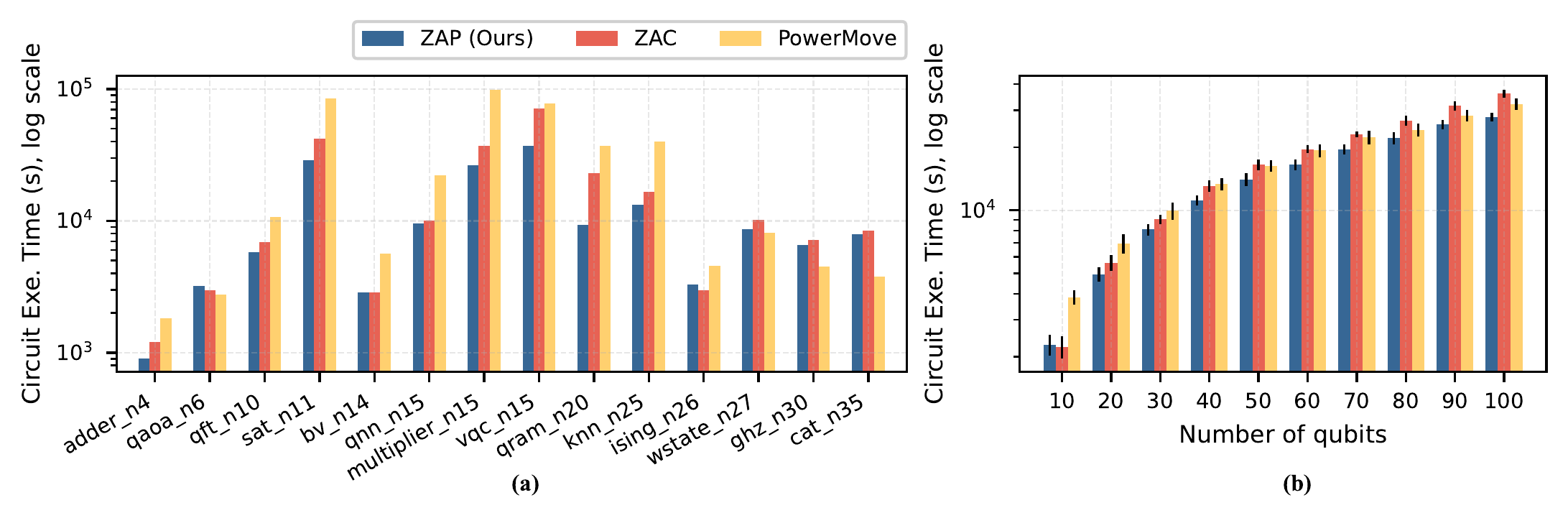 Figure 2. Circuit physical execution time comparison between ZAP, ZAC, and PowerMove on a suite of structured quantum-algorithm benchmarks and random 3-regular circuits.
Classical-side compilation efficiency is the most prominent strength of ZAP. Compared with the ZAC framework from the University of California, Los Angeles and the PowerMove framework from the University of California San Diego, ZAP reduces compilation time from tens of seconds to below 0.1 seconds on multiple benchmarks, achieving speedups exceeding 1,000×. Compared with Enola, ZAP achieves more than 10,000× speedup on the evaluated benchmark suite. On 100-qubit random circuits, ZAP still keeps compilation time below 0.1 seconds. Figure 3 presents the compilation-time comparison.
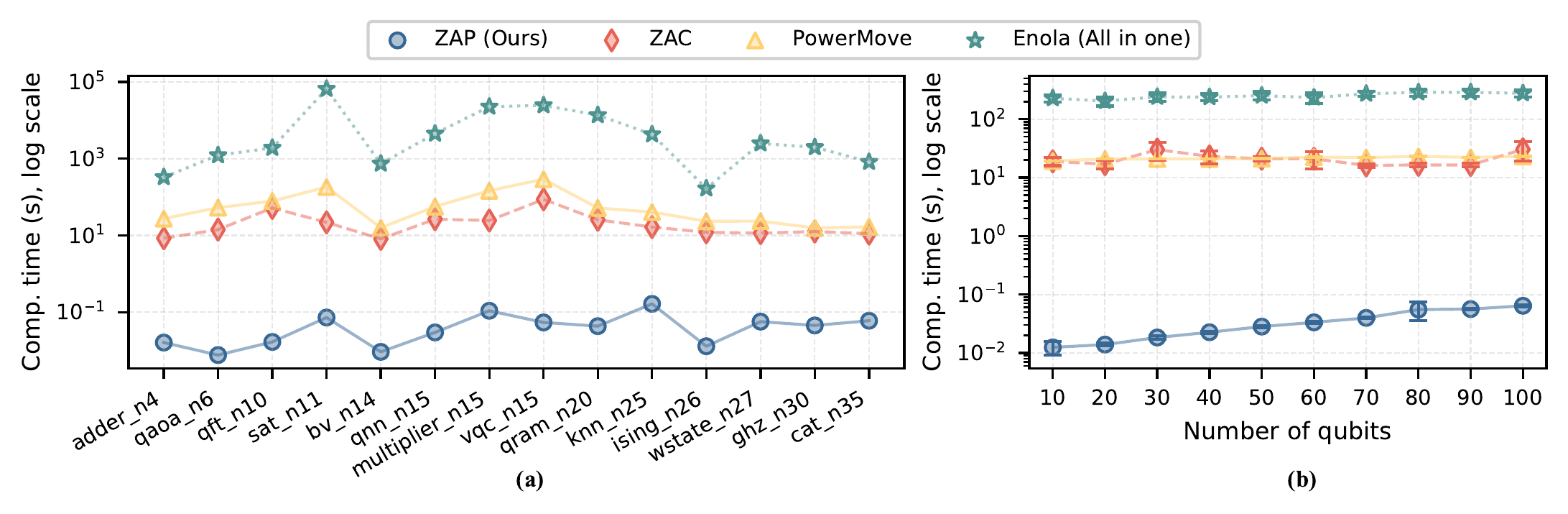
Figure 3. Classical compilation time comparison among ZAP, ZAC, PowerMove, and Enola on structured quantum-algorithm benchmarks and random circuits.
Further scalability tests show that ZAP maintains strong compilation scalability as the qubit count grows. The research team selected four representative algorithms—Ising, Cat, Adder, and QFT—and scaled the evaluation up to 500 qubits. The results show that even at the 500-qubit scale, ZAP’s compilation time remains significantly lower than those of ZAC and PowerMove. In particular, for a 500-qubit QFT circuit, ZAP completes compilation within one minute. Figure 4 shows the scalability results.
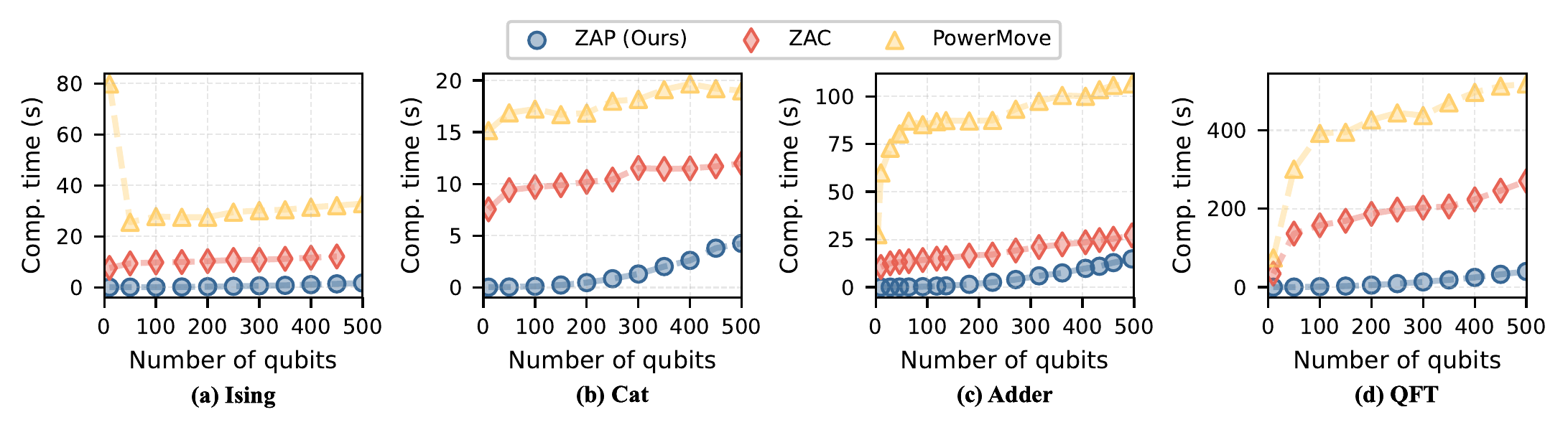
Figure 4. Compilation-time scalability of ZAP compared with ZAC and PowerMove as the Ising, Cat, Adder, and QFT algorithms are scaled up to 500 qubits.
Fidelity analysis indicates that ZAP’s advantages mainly arise from its effective control of crosstalk and atom-transport overhead. For structured circuits with irregular connectivity and nonuniform qubit-reuse patterns, the zoned architecture, look-ahead placement, and dynamic idle-qubit management of ZAP effectively reduce unnecessary back-and-forth transport and accumulated crosstalk. On random circuits, where the topological structure faced by different compilers is more uniform, ZAP still preserves a stable scalability advantage. Figure 5 shows the fidelity breakdown on structured benchmark circuits, with different colors corresponding to two-qubit gates, atom transport, decoherence, and crosstalk.
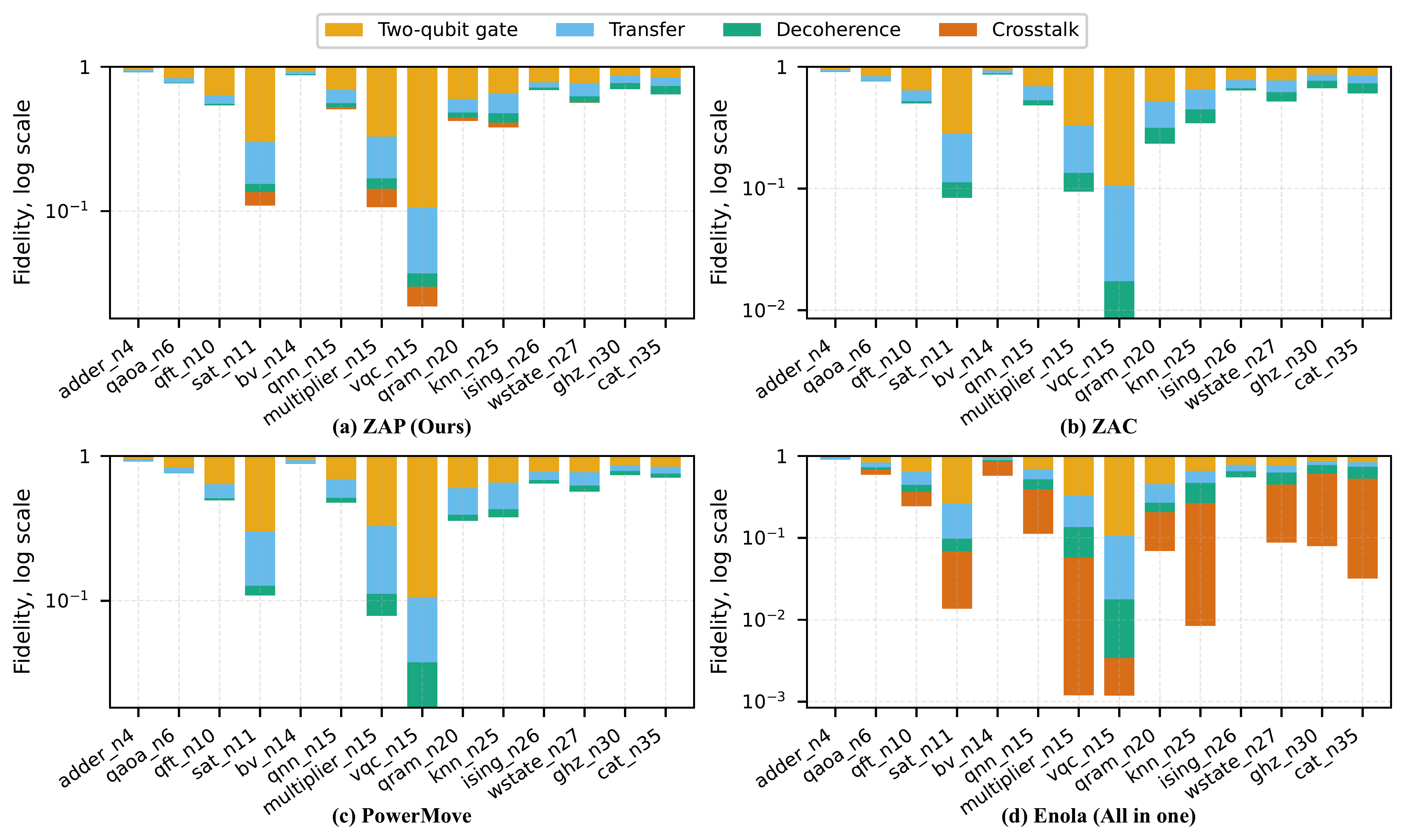
Figure 5. Fidelity decomposition comparison among ZAP, ZAC, PowerMove, and Enola on structured quantum-algorithm benchmark circuits. The figure separates the effects of two-qubit gates, atom transport, decoherence, and crosstalk on overall fidelity.
This study shows that as neutral-atom quantum computing moves toward larger-scale systems, the compiler is not merely a “translator” between algorithms and hardware. It is also critical infrastructure that affects system throughput, experimental feedback cycles, and the user experience of quantum cloud services. By combining a zoned hardware structure with a non-iterative compilation strategy, ZAP turns the complex mapping problem for dynamically reconfigurable atom arrays into an efficient, controllable, and deterministic workflow. The work provides an important reference for future neutral-atom compilation and hardware-software co-design for large-scale and ultimately fault-tolerant quantum computing.
The co-first authors of the paper are BAQIS interns Chen Huang and Xi Zhao, and BAQIS Assistant Research Fellow Hongze Xu. The corresponding authors are BAQIS Assistant Research Fellow Jingbo Wang, BAQIS Associate Research Fellow Meng-Jun Hu, and BAQIS Adjunct Researcher and Tsinghua University Associate Professor Dong E. Liu. The collaborators also include BAQIS Assistant Research Fellow Weifeng Zhuang. Participating institutions include Tsinghua University, the University of Science and Technology of China, The Chinese University of Hong Kong, and Hefei National Laboratory. This work was supported by the National Key Research and Development Program of China, the Beijing Natural Science Foundation, the National Natural Science Foundation of China, and the Innovation Program for Quantum Science and Technology.
Original paper link: https://ieeexplore.ieee.org/document/11535023