 中文
中文 Email
Email QCloud
 Log in

Quantum Interface Devices and Systems Group Achieved Superior Frequency Stability and Long-Lived State Swapping in Cubic-SiC Mechanical Mode Pairs
2026/03/04
Recently, the team at Beijing Academy of Quantum Information Sciences (BAQIS) has made significant progress in the study of multimode cavity optomechanics based on silicon carbide (SiC) membrane mechanical resonators. The research team systematically investigated mode degeneracy breaking, frequency stability, and state swapping phenomena of mechanical modes in a multimode cavity optomechanical system. The related findings provide a new approach for high-precision characterization of non-uniform stress in thin-film materials, as well as for the development of multimode phononic quantum information storage devices and quantum networks. On February 26, 2026, this work was published in npj Quantum Information under the title "Superior Frequency Stability and Long-Lived State-Swapping in Cubic-SiC Mechanical Mode Pairs."
As important mediators of interactions among heat, electricity, and light, phonons have wide applications in thermal management, materials science, and quantum information processing. Optomechanical and electromechanical systems based on multiple mechanical modes not only hold great promise for quantum storage and quantum transduction but also serve as ideal platforms for studying interesting physical phenomena such as quantum entanglement, multimode phonon lasing, and non-reciprocal photon/phonon transmission. Currently, multimode optomechanical or electromechanical systems are mainly constructed through two approaches: integrating a microwave or optical cavity with spatially separated mechanical resonators, or coupling different-order modes within a single mechanical resonator to the same cavity mode.
For a typical square membrane resonator under isotropic stress, modes with the same indices m and n become degenerate. Although these degenerate modes share the same resonance frequency, their mode shapes differ, which limits the number of mechanical modes that can couple to a given cavity mode. Moreover, dark states spontaneously formed by degenerate mechanical modes can hinder ground-state cooling as well as the preparation of macroscopic squeezed states or entangled states. An important finding is that introducing anisotropic stress along the x- and y-axes in the membrane can lift the degeneracy of mechanical modes. These anisotropy-induced degenerate-broken modes exhibit similar vibration shapes and close resonance frequencies, offering a new route for constructing multimode systems in which a single optical mode couples to multiple pairs of mechanical modes. Figure 1 shows a schematic of a square SiC membrane resonator and the out-of-plane mode shapes under isotropic and anisotropic stress.
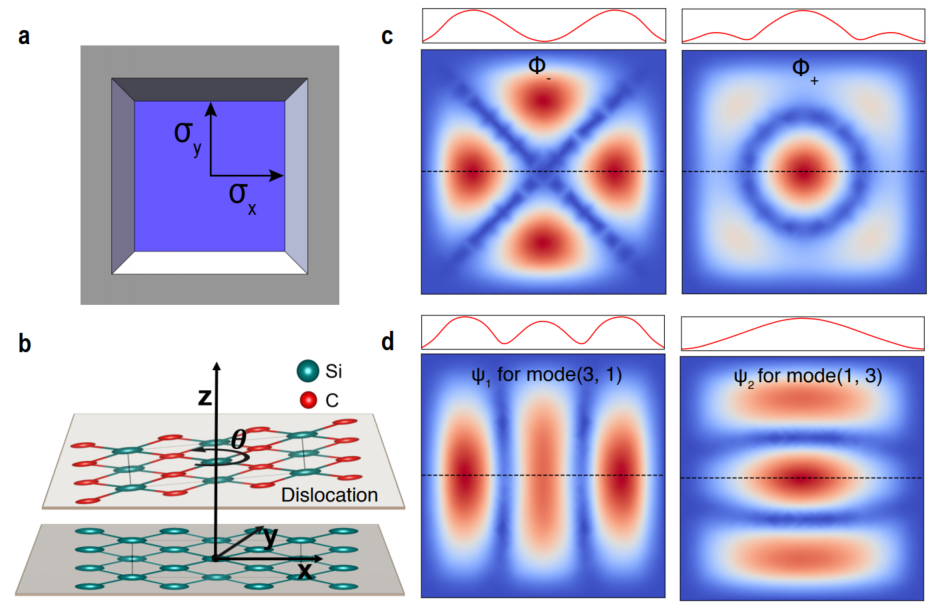
Figure 1. Schematic of a square silicon carbide (SiC) membrane resonator and out-of-plane mode shapes under isotropic and anisotropic stress. (a) Schematic of the square SiC membrane resonator. (b) Schematic illustration of the origin of stress anisotropy, caused by the rotational misalignment between the Si substrate and the overlying 3C-SiC layer during epitaxial growth. (c) Surface vibration profiles of two out-of-plane modes of a square membrane under isotropic stress. (d) Surface vibration profiles of the out-of-plane (3,1) and (1,3) modes of a square membrane under anisotropic stress.
Considering the influence of anisotropic stress on the vibration modes of mechanical resonators, the research team derived an analytical expression for the resonance frequency of a thin membrane under anisotropic stress. By collectively fitting 57 mechanical modes, the results revealed differences in stress along different directions at the sub-MPa level, significantly outperforming the capabilities of existing commercial thin-film stress analysis instruments. Current conventional stress analysis techniques, such as X-ray diffraction and Raman spectroscopy, typically have resolutions on the order of tens of MPa. The results of mechanical mode degeneracy breaking and resonance characterization are shown in Figure 2. This research method provides a new approach for high-precision characterization of non-uniform stress in thin-film materials.
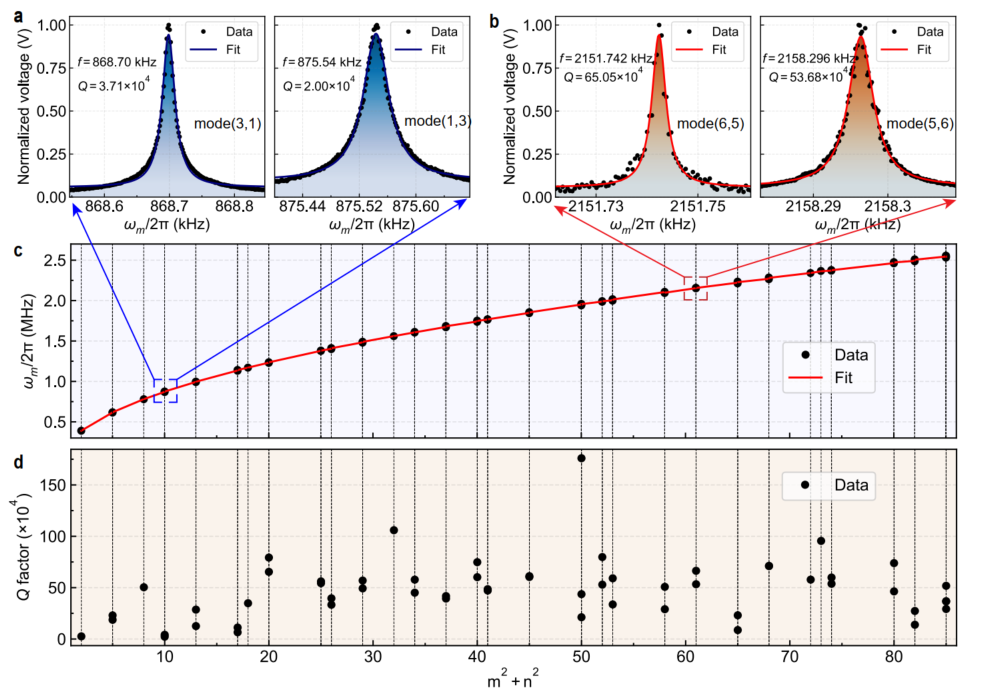
Figure 2. Characterization of degenerate mode breaking in the SiC membrane resonator at (a) low frequencies and (b) high frequencies. (c) Resonance frequencies of mechanical modes as a function of mode indices. The black dots represent experimental results, and the red solid line represents the theoretical fit. (d) Experimental results of the quality factors of mechanical vibration modes.
Furthermore, by integrating the silicon carbide membrane resonator with a superconducting microwave cavity, the research team constructed a cavity electromechanical system based on the SiC membrane resonator. Experimental results based on this system demonstrated that, at a cryogenic temperature of 10 mK, themechanical modes exhibit quality factors on the order of 108. As shown in Figure 3, Allan deviation analysis reveals a frequency stability of 6×10⁻¹⁰ for the mechanical resonator at an integration time of 3×10⁴ seconds. This result represents the highest level of frequency stability for out-of-plane vibration modes reported in the literature to date.
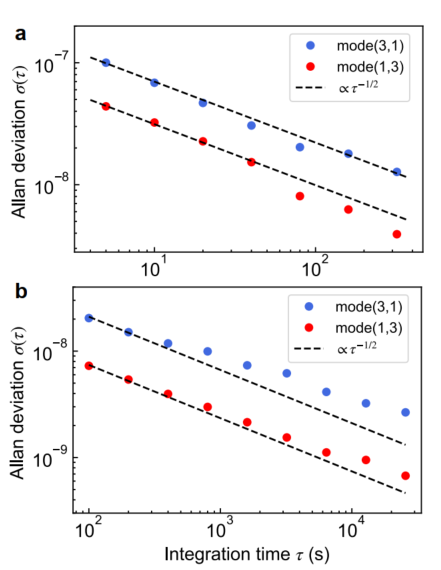
Figure 3. Allan deviation of the mechanical modes (3,1) and (1,3) as a function of integration time. The sampling time intervals are (a) 5 seconds and (b) 100 seconds. The black dashed line represents the least-squares fit to the noise model σ(τ)=Aτ-1/2τ.
Leveraging the high quality factors of the mechanical modes and the strong coupling between two mechanical modes and a shared cavity mode, the research team successfully demonstrated coherent state swapping between nearly degenerate mechanical mode pairs using the stimulated Raman adiabatic passage (STIRAP) scheme. A state transfer efficiency exceeding 78% was achieved. Figure 4 illustrates the optomechanical STIRAP scheme and the temporal evolution of the phonon population in the mechanical modes during the state swapping process.
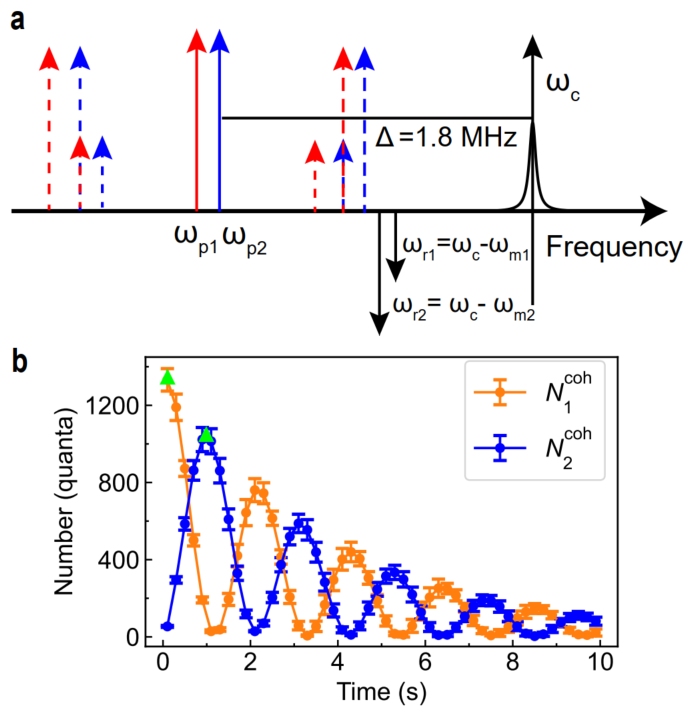
Figure 1. (a) Frequency diagram of the optomechanical STIRAP scheme. The black downward arrows represent the red sidebands, whose frequency detuning from the cavity resonance matches the frequencies of the two mechanical modes. The swap drive signals are represented by solid upward red and blue arrows, and the corresponding sidebands are indicated by dashed arrows. The state swap between the two mechanical modes is induced by the overlap of the sidebands. (b) Coherent occupation numbers of the two mechanical modes as a function of swap time.
In summary, the research findings not only provide a new approach for stress analysis of thin-film materials but also open up new avenues for the development of quantum networks and quantum simulations based on multimode phononic devices.
The first authors of the paper are Sun Huanying, assistant researcher at BAQIS, Chen Yanlin, a Ph.D. student, and Liu Qichun, senior engineer. The corresponding authors are Liu Yulong, associate researcher at BAQIS, and Li Tiefu, adjunct researcher at BAQIS. The paper also lists Wu Haihua and Wang Yuqing, senior engineers at BAQIS, as co-authors. This work was supported by the National Natural Science Foundation of China, the Beijing Natural Science Foundation, and other funding sources.
Article Link: https://doi.org/10.1038/s41534-026-01200-7