 中文
中文 Email
Email QCloud
 Log in

In-situ Quantum Transport Group Has Observed Quasi-One-Dimensional Magnon Transport in a Two-Dimensional Spin Lattice Induced by Magnon Flat-Band
2026/03/23
Recently, the In-situ Quantum Transport Group led by Prof. Jian-Hao Chen, in collaboration with Peking University, Tsinghua University, Fudan University, and other institutions, has for the first time observed quasi-one-dimensional long-range magnon spin transport induced by magnon flat band in the two-dimensional frustrated stripe-type antiferromagnet CrOCl. The related research paper titled “Flat band induced quasi-one-dimensional magnon transport in a two-dimensional spin lattice” has been published in Nature Communications on March 21, 2026.
With the development of miniaturization and integration of next-generation spintronic devices, designing one-dimensional magnon spin transport can effectively avoid signal crosstalk caused by increased device integration density. However, one-dimensional spin systems cannot form long-range order, and long-distance spin transport has not yet been observed by researchers. Although periodic stripe-type magnetic domain structures can suppress cross-channel magnon transport, the domain formation is associated with long-range dipolar interactions, which can confine the domain channel width to the order of a hundred nanometers—still insufficient for true one-dimensional spin transport. In contrast, two-dimensional materials offer a more feasible platform for constructing physical systems that are difficult to realize through conventional methods.
The two-dimensional magnetic material CrOCl possesses an atomic-scale periodic stripe-type antiferromagnetic structure: spins are ferromagnetically coupled along the a-axis, while along the b-axis they exhibit a frustrated antiferromagnetic coupling with an eight-ferromagnetic-chain period (Fig. 1a). Calculations reveal that the magnon dispersion in CrOCl shows strongly quasi-one-dimensional characteristics (Fig. 1b): along the a-axis, the magnon band is highly dispersive, while along the b-axis, it exhibits flat band features. This indicates that CrOCl is a suitable platform for realizing quasi-one-dimensional magnon spin transport.
Using non-local spin excitation and detection methods, the research team measured magnon transport behavior along both crystallographic directions in CrOCl crystals. Magnon transport along the a-axis is significantly enhanced (Fig. 2), with an decay length reaching 7μm—superior to the reported values for two-dimensional materials, while transport along the b-axis is strongly suppressed. The ratio of decay lengths between the two directions is approximately 4, which is very close to the calculated value of 3.8 derived from the magnon band structure. This study reveals the potential of two-dimensional materials for constructing novel atomic-scale magnetic structures and achieving one-dimensional magnon spin transport, which is of great significance for the large-scale integration of magnonic devices.
The first authors of the paper are Bingcheng Luo (Ph.D. student) and Mantang Chen (Ph.D. student) from the International Center for Quantum Materials at Peking University. The corresponding authors are Assistant Researcher Di Chen (BAQIS), Postdoctoral Fellow Shaomian Qi (Peking University), and Professor Jian-Hao Chen (BAQIS /Peking University). Co-authors include CAS Academician Xin-Cheng Xie, Professor Yu Ye, and Researcher Zhida Song from Peking University; Professor Qihua Xiong (BAQIS /Tsinghua University); Senior Engineer Yuanjun Song (BAQIS); Professor Jiang Xiao (Fudan University); Professor Zheng Han (Shanxi University), etc. This work was supported by the National Key R&D Program of China, the National Natural Science Foundation of China, and the Strategic Priority Research Program of the Chinese Academy of Sciences.
Article link:: https://www.nature.com/articles/s41467-026-70912-3
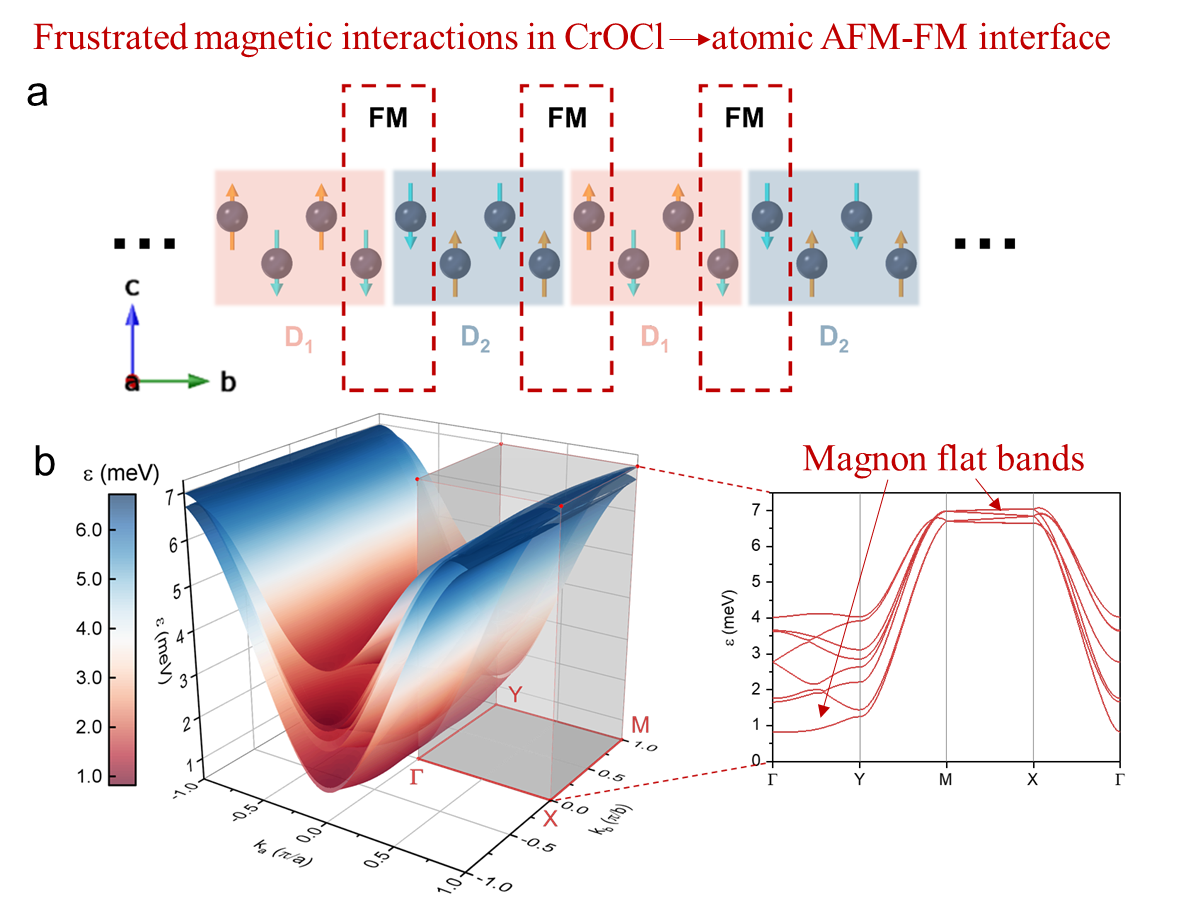
Fig. 1 Magnetic structure and quasi-one-dimensional magnon flat-band of CrOCl. (a) Aomic-scale stripe-like antiferromagnetic order of CrOCl. (b) Magnon dispersion of CrOCl, along the a-axis, the magnon band is highly dispersive, while along the b-axis, it exhibits flat band features.
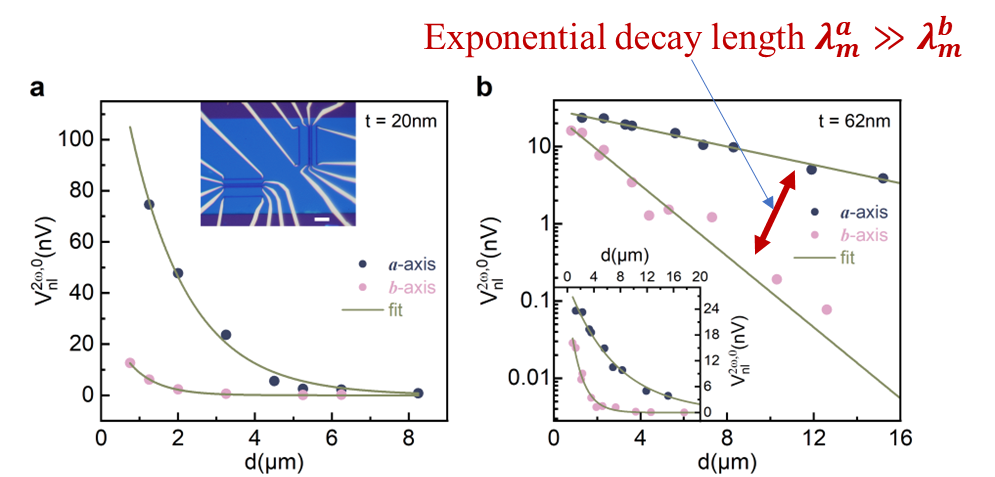
Fig. 2 Quasi-one-dimensional magnon transport in CrOCl. (a) Distance-dependent decay behavior of magnons along the a-axis (navy) and b-axis (pink). The dark green solid line is an exponential decay fit. The data are collected from sample with thickness of 20 nm. (b) Same as (a), but the data are collected from another sample with thickness of 62 nm.