 中文
中文 Email
Email QCloud
 Log in

Online users have made significant scientific research progress based on the Quafu quantum cloud computing platform
2026/03/27
Recently, online users conducted two scientific studies using the Quafu quantum computing cloud platform, and the results were published in the journals Physical Review A and Physical Review Applied, respectively.
Result 1: Achieving efficient quantum state tomography using an auxiliary system
Quantum state tomography is a fundamental technique in quantum information science for reconstructing the density matrix of an unknown quantum state, thereby providing complete information about the state. It plays a crucial role in quantum computation, quantum communication, and quantum simulation. However, as the size of the quantum system increases, the number of measurement settings and sampling requirements for quantum state tomography grow exponentially with the number of qubits. This not only complicates experimental design and implementation but also leads to substantial consumption of experimental resources. These limitations significantly hinder the application of state tomography in large-scale quantum systems. To reduce the number of measurement settings and improve sampling efficiency, this study proposes a tomography method based on auxiliary systems. The method can be implemented either through entanglement between the quantum system to be measured and a quantum auxiliary system or through correlations between the quantum system and a probabilistic classical auxiliary system. Measurements performed on the joint system enable more efficient extraction of information about the target quantum state. The method relies on standard quantum gate operations and requires only two measurement settings, with a total sampling complexity scaling as O(d2) for the system of interest with d dimensions, significantly simplifying experimental operations and measurement processes. Additionally, this study provides two schemes for purity estimation based on the proposed circuit, one of which achieves estimation precision at the Heisenberg limit. The effectiveness of the proposed method is validated through detailed theoretical analysis, numerical simulations, and cloud-based quantum computing demonstrations.
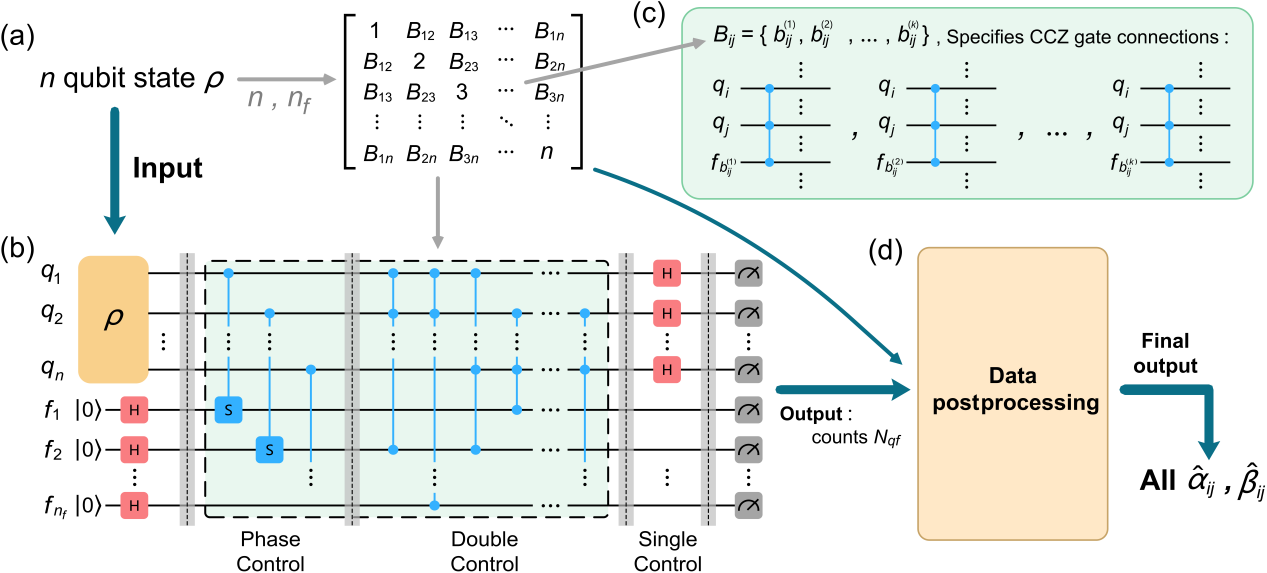
Figure 1. ACQST's methodological framework and workflow
Result 2: Experimental verification of the algorithm for simultaneously solving multi-level problems
Determining the ground and low-lying excited states is critical in numerous scenarios. Recent work has proposed the ancilla-entangled variational quantum eigensolver (AEVQE) that utilizes entanglement between ancilla and physical qubits to simultaneously target multiple low-lying energy levels. In this work, we report the implementation of the AEVQE on a superconducting quantum cloud platform, demonstrating the full procedure of solving the low-lying energy levels of the H2 molecule and the transverse-field Ising models (TFIMs). We obtain the potential energy curves of H2 and show an indication of the ferromagnetic to paramagnetic phase transition in the TFIMs from the average absolute magnetization. Moreover, we investigate multiple factors that affect the algorithmic performance and provide a comparison with ancilla-free VQE algorithms. Our work demonstrates the feasibility of the AEVQE algorithm and offers guidance for the VQE approach in solving realistic problems on publicly accessible quantum platforms.
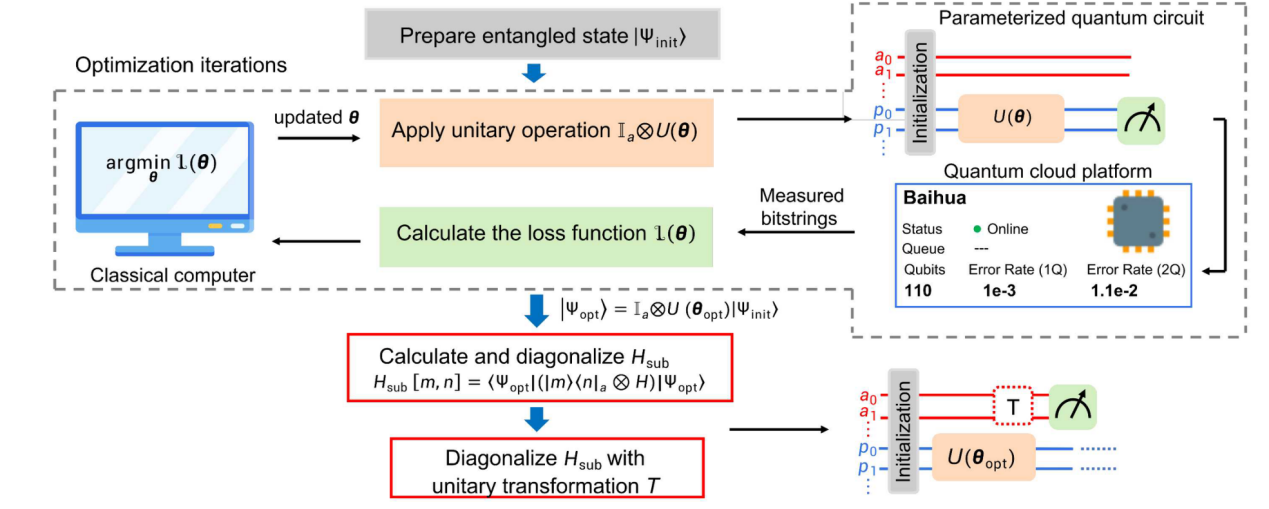
Figure 2. Flowchart of AEVQE algorithm
As of May 15, 2026, the Quafu quantum cloud computing platform has been operating continuously for over 1100 days, with over 5,700 registered users and over 9 million total tasks executed. The platform has served users across 24 countries and regions, contributing to more than 20 published research papers. With the implementation of national-level projects, the Beijing Academy of Quantum Information Sciences will provide higher-quality physical quantum computing resources to users both domestically and internationally, fostering the development and growth of the quantum computing ecosystem.
Quafu quantum computing cloud platform website: https://quafu-sqc.baqis.ac.cn