 中文
中文 Email
Email QCloud
 Log in

Low-dimensional Quantum Materials Group and Collaborators Reported the Achievement of Switchable Chiral Nonlinear Optical Response
2024/12/24
Recently, Kai Chang's group, in collaboration with Kian Ping Loh's group from National University of Singapore and Dr. Heng Gao's group from Shanghai University, has achieved the synergistic control of second-harmonic circular dichroism through electric and optical fields. This work, entitled “Dion–Jacobson Perovskites with a Ferroelectrically Switchable Chiral Nonlinear Optical Response”, was published in Journal of the American Chemical Society on December 19, 2024.
Nonlinear optics (NLO) is one of the important research fields of light-matter interactions, especially the electric field-controlled second harmonic generation (SHG), which has a wide range of application potential in optical switches and communications. However, materials that can simultaneously achieve SHG and circular dichroism (CD) electric field control are very rare, as this poses strict requirements on the crystal structure and optical activity. In recent years, two-dimensional organic-inorganic hybrid perovskite materials have attracted much attention due to their unique structural characteristics and efficient nonlinear optical responses. By introducing chiral organic ligands, their optical activity can be further enhanced and possible ferroelectric polarization responses can be induced, providing the possibility for the synergistic control of SHG-CD by electric and optical fields.
Recently, Assistant Research Scientist Jiesu Wang from the low-dimensional quantum materials team, along with collaborators, discovered that the ferroelectric chiral two-dimensional Dion-Jacobson phase hybrid organic-inorganic perovskite material (s-(FBDA)CdCl4) exhibits electrically controllable second harmonic generation-circular dichroism (SHG-CD). The schematic of the nonlinear multipolar effect is shown in Figure 1. The introduction of chiral fluorinated amine molecules drives the formation of structural chirality and induces the emergence of ferroelectricity. Environmental stability tests have shown that this material exhibits structural and ferroelectric domain stability for over two years under ambient conditions in Singapore, and it also demonstrates a high laser threshold, making it an ideal candidate for practical applications. In the photoelectric synergy test, researchers observed the switching of SHG-CD under ferroelectric field control, as shown in Figure 2, where the SHG signal of the sample is sensitive to right circularly polarized light after positive bias polarization, and sensitive to left circularly polarized light after negative bias polarization. Theoretical calculations reveal that this phenomenon originates from the reconfiguration of the multipolar effect within the material during the reversal of ferroelectric polarization, thereby altering the optical response sensitivity to circularly polarized light.
Furthermore, based on the XOR logic operation enabled by the electrically switchable SHG-CD, researchers have constructed a photonic communication experimental simulation platform to demonstrate its application in advanced photonic communication systems. As shown in Figure 3, in this system, the excitation light and the second harmonic signal serve as the carriers for information transmission. Controlling the circular polarization state (left-handed/ right-handed) of the excitation light allows for binary encoding and transmission of information at the sender end. Statistically receiving the strong/weak (1/0) SHG signals at the receiver end can generate the corresponding binary information. The applied electric field is used to change the polarization state of the material, thereby randomly adjusting the circular polarization sensitivity of SHG (the strength of the SHG signal), achieving dynamic encryption and decryption of data.
This work not only enhances the bandwidth and security of data transmission but also promotes the development of photonic communication systems towards quantum communication. It injects new vitality into the fields of photonic communication and nonlinear optics and demonstrates the broad application potential of two-dimensional chiral ferroelectric perovskites in high-security optical communication, optical logic computing, and other photonic technologies.
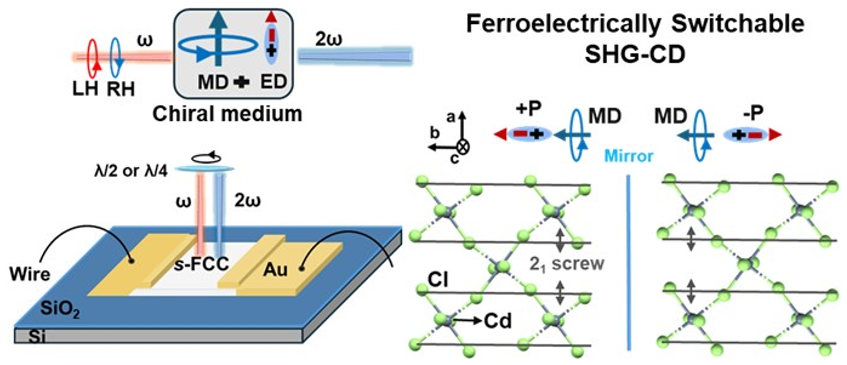
Figure 1. (Left) Schematic showing the measurement configuration of the electrically controllable SHG-CD. (Right) Schematic showing the top view of the perovskite framework in two different ferroelectric states.
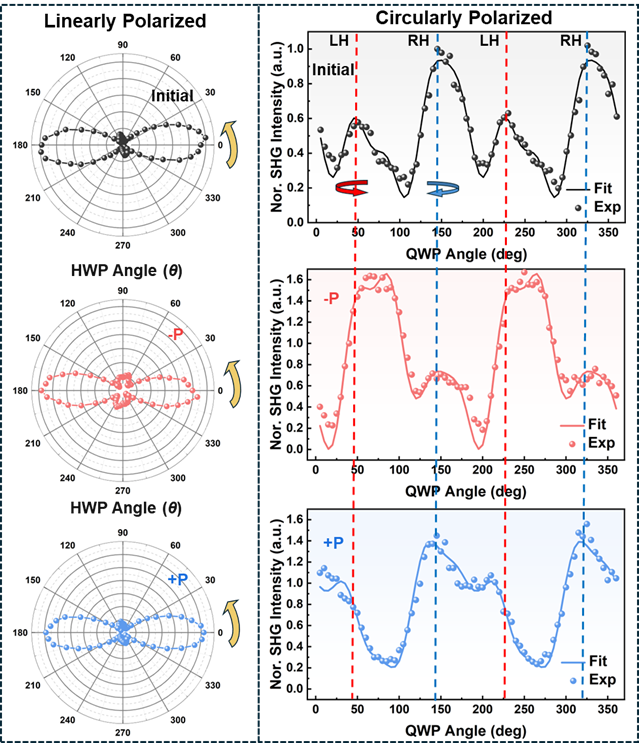
Figure 2. The linearly and circularly polarized SHG responses of the s-FCC crystals after positive and negative bias polarization.
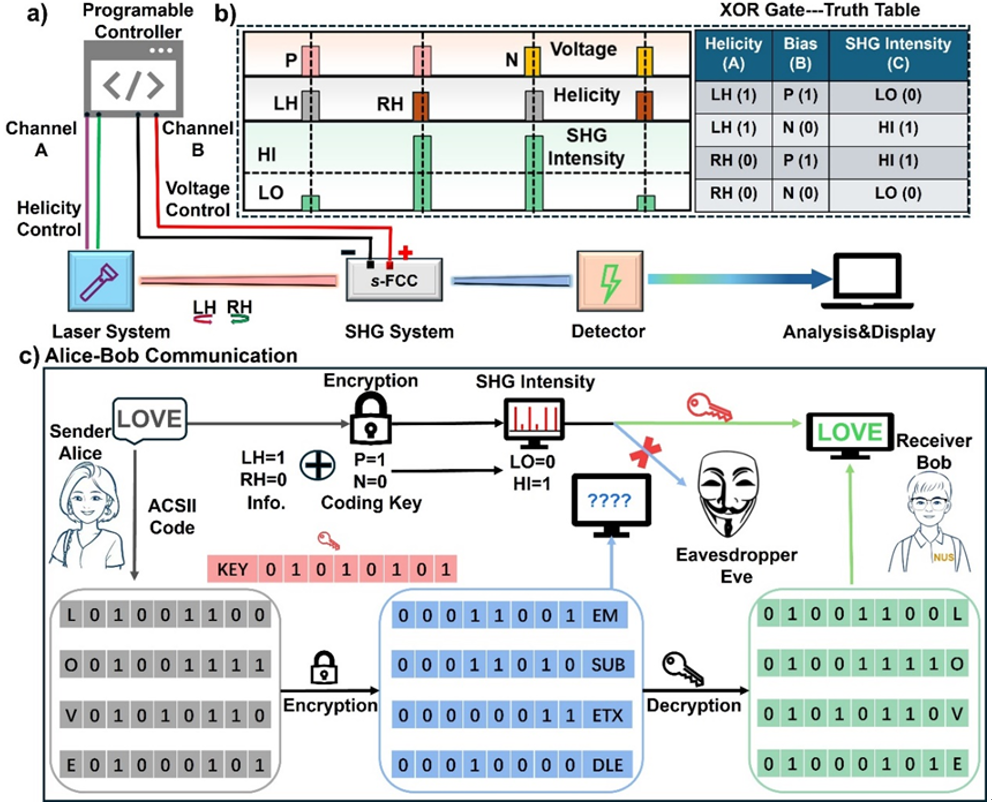
Figure 3. Schematic of the encrypted optical communication system based on the Ferroelectrically Switchable Chiral Nonlinear Optical Response.
The first authors of this work are Weixin He (PhD student from the National University of Singapore), Changjiang Chen (Master's student from Shanghai University), and Shiyao Wu (Senior Engineer from the BAQIS). The corresponding authors are Jiesu Wang (Assistant Research Scientist from the BAQIS), Kian Ping Loh (Professor from the National University of Singapore), and Heng Gao (Doctor from Shanghai University). Other collaborators include Chang Kai (Research Scientist from the BAQIS), Walter P. D. Wong, and Wu Zhenyue (Postdoctoral Fellows from the National University of Singapore). This work was supported by grants from the National Natural Science Foundation of China, the Beijing Natural Science Foundation and other projects.
Paper link: https://pubs.acs.org/doi/10.1021/jacs.4c13604