 中文
中文 Email
Email QCloud
 Log in

Progress on brightness-limited single-photon purity of heralded single-photon sources
2025/02/16
Recently, Quantum Photonics team of Beijing Academy of Quantum Information Science (BAQIS) completed the theoretical modeling and experimental demonstration of the ideal single-photon purity for general parametric heralding single-photon sources. The achievement, titled "Bright Heralded Single Photon Source Saturating Theoretical Single Photon Purity," was published in Laser & Photonics Review on February 7, 2025.
Single photons are a precious resource for invulnerable quantum key distribution. They can either be produced on-demand by quantum emitters, or heralded from spontaneous parametric photon-pair generation processes. The latter approach has the advantage of room-temperature operation and inherent compatibility with photonic waveguide integration. Single-photon purity is a key parameter for evaluating the performance of an HSPS. It is measurable by the heralded auto-correlation function gh(2)(0). While a value close to 0 is desirable for quantum applications, the actual gh(2)(0) value of an HSPS depends on the source brightness.
A stronger pump produces a larger number of heralded single photons per unit time, but at the intrinsic expense of single-photon purity due to the increased probability of multi-pairs. To complicate further, single-photon purity is strongly affected also by the residual pump and spontaneous Raman photons leaked into the heralded path through imperfect spectral filtering. So far, there lacks a simple criterion to determine whether an HSPS has reached its theoretical single-photon purity.
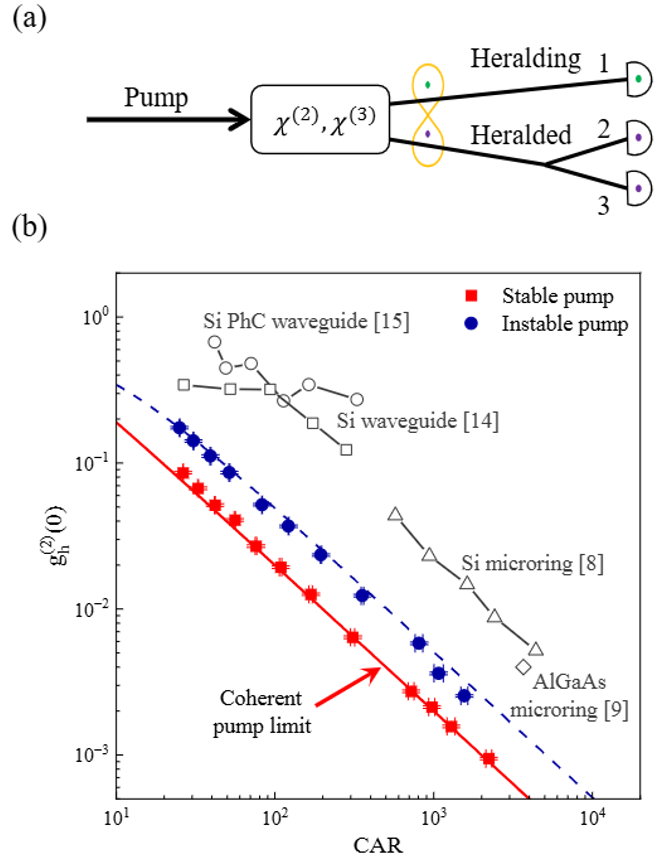
Figure 1. (a) A schematic for measuring single-photon purity of HSPS. (b) The theoretical limit of single-photon purity
To bridge this gap, the team derive an explicit theoretical limit for single-photon purity of HSPS sources under coherent pump condition (Figure 1(b)). Subsequently, this limit was demonstrated on a chip-based spontaneous four-wave mixing (SFWM) heralded single-photon source with a 2.5-GHz pulsed pump. The non-linear SFWM medium is a small-footprint spiral waveguide structure fabricated on silicon-on-insulator (SOI) platform (Figure 2(b) and (c)).
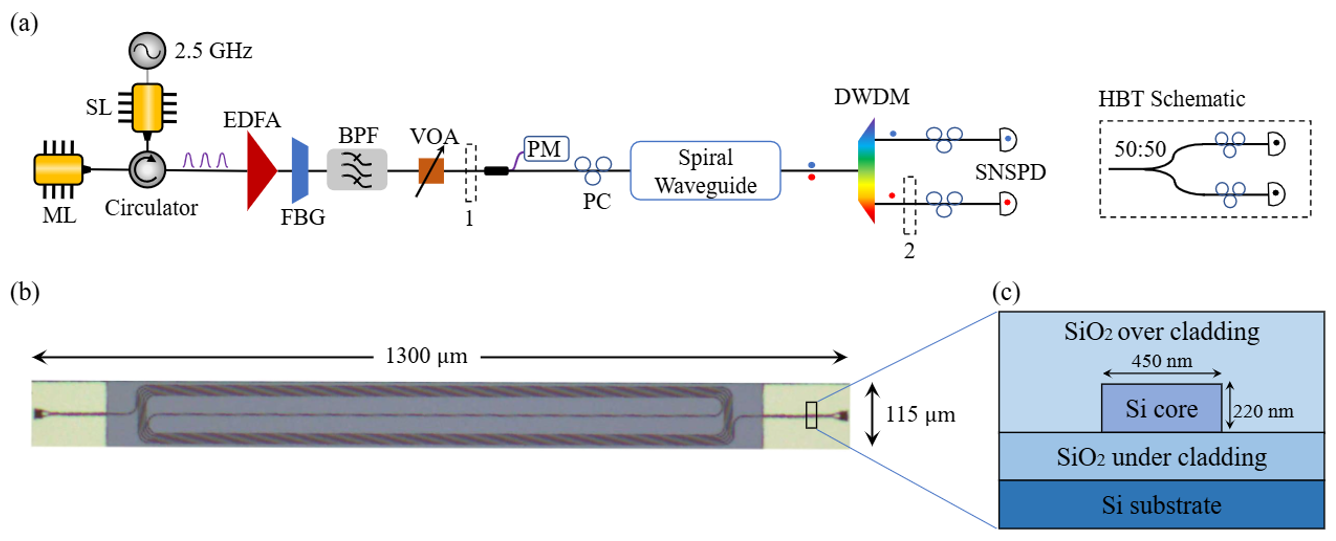
Figure 2. (a) Experimental setup. (b) Image of the rectangular spiral waveguide by a microscope (c) Schematic of the waveguide cross-section.
The performance of the heralded single-photon source designed by the team also reached a state-of-the-art level (Table 1). Under a strong pump, it achieves an unprecedentedly high coincidence rate of 1.51 MHz with a coincidence-to-accidental ratio (CAR) of 16.77 (Figure 3). The source under a weak pump is measured to have the lowest gh(2)(0) value of together with a coincidence rate of 0.8 kHz.
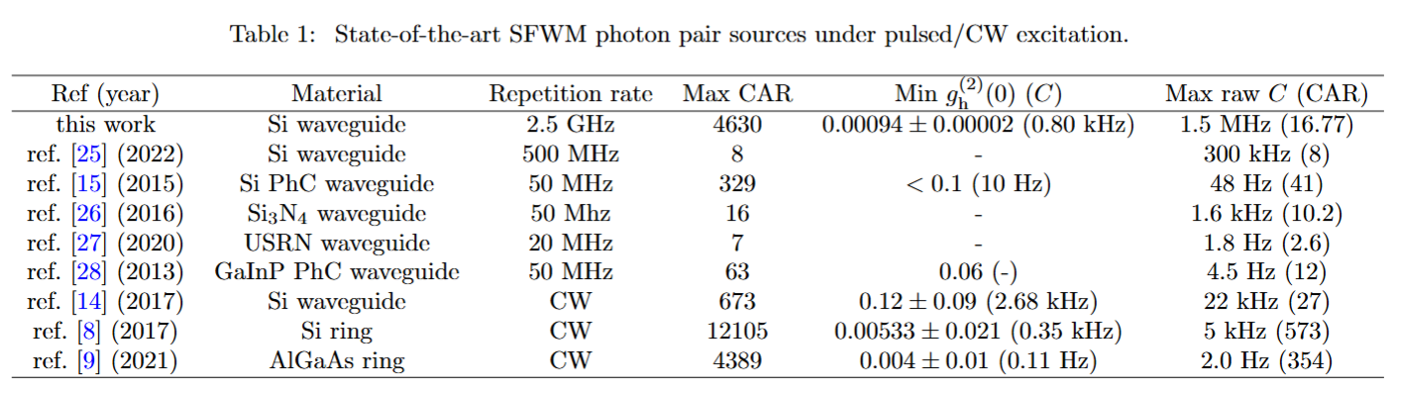
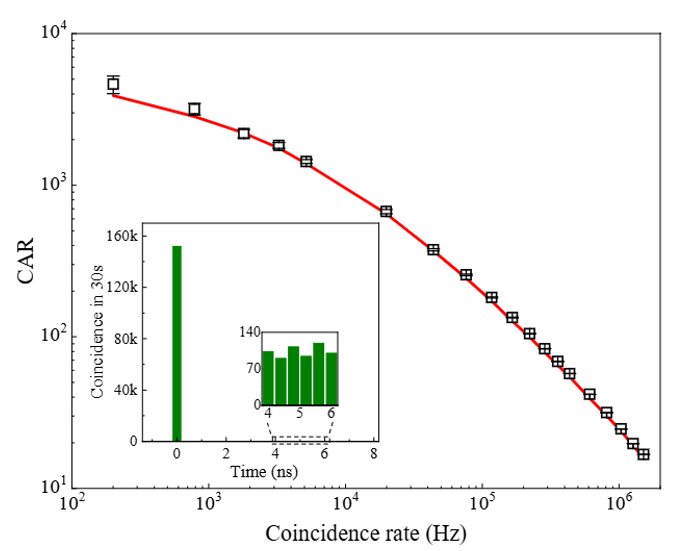
Figure 3. CAR versus coincidence rate.
Finally, based on the proposed theory, the authors derived the theoretical curves under the condition of pump intensity fluctuation. They verified it by exciting the light source with an unstable pump. The experimental values fit perfectly with the theoretical values, thereby validating the reliability of the theory.
The first author of this paper is Haoyang Wang, a doctoral student from BAQIS/Beijing University of Posts and Telecommunications, and the corresponding author is Qiang Zeng, an assistant researcher at BAQIS. This work is supported by the National Natural Science Foundation of China.
Team homepage: http://qp.baqis.ac.cn
Ref link: https://onlinelibrary.wiley.com/doi/10.1002/lpor.202401420